Aquafinancial Consulting
  • HOME
  • SERVICES
    • INDIVIDUALS & FAMILIES
      • FINANCIAL ADVICE
      • RETIREMENT PLANNING
      • ESTATE PLANNING FOR YOUNG FAMILIES
      • ESTATE PLANNING FOR RETIREES & MATURE FAMILIES
      • INSURANCE PLANNING
    • BUSINESS OWNERS
      • FINANCIAL ADVICE
      • RETIREMENT PLANNING
      • ESTATE PLANNING
      • SUCCESSION PLANNING
      • INSURANCE PLANNING
    • INCORPORATED PROFESSIONALS
      • FINANCIAL ADVICE
      • RETIREMENT PLANNING
    • INSURANCE
      • DISABILITY
      • CRITICAL ILLNESS
      • LIFE
        • PERSONAL
        • CORPORATE
      • HEALTH & DENTAL
      • FOR YOUNG FAMILIES
      • FOR BUSINESS OWNERS
    • INVESTMENT
      • REGISTERED EDUCATION SAVINGS PLAN
      • TAX FREE SAVINGS ACCOUNT
      • REGISTERED RETIREMENT SAVINGS PLAN
      • REGISTERED RETIREMENT INCOME FUND
      • ANNUITIES
    • GROUP BENEFITS
      • HEALTH BENEFITS
      • RETIREMENT BENEFITS
  • ABOUT
    • ABOUT
    • SUPPLIERS
    • PRIVACY & WEBSITE TERMS OF USE
  • NEWS
  • EVENTS
  • CONTACT
  • Click to open the search input field Click to open the search input field Search
  • Menu Menu
  • Link to LinkedIn
  • Link to Facebook
  • Link to X

Archive for category: RDSP

2021 Financial Calendar

January 4, 2021/in 2021, Blog, personal finances, RDSP, Registered Education Savings Plan, Retirement, RRSP, Tax, Tax free savings account/by Aquafinancial Consulting

We’ve put together a financial calendar for 2021. It contains all the dates you need to know to make the most of your government benefits and investment options. Whether you want to bookmark this or print it out and post it somewhere prominent, you’ll have everything you need to know in one place!

We’ve provided information on:

  • The dates when the government distributes payments for the Canada Child Benefit, the Canada Pension Plan (CPP) and Old Age Security (OAS).

  • When GST/HST credit payments are issued – usually on the fifth day of January, April, July and October.

  • All the dates the Bank of Canada makes an interest rate announcement. A change in this interest rate (up or down) can impact a bank’s prime interest rates. This can then affect anything from the interest rate charged on your mortgage and line of credit to how much the Canadian dollar is worth against other currencies.

  • When you can start contributing to your Tax Free Savings Account (TFSA) for 2021, the contribution limit for 2021 is $6,000.

  • March 1st is the last day for your 2020 Registered Retirement Savings Plan (RRSP).

  • December 31st , 2021 is the last day for 2021 charitable contributions.

  • December 31st is the deadlines for various investment savings vehicle contributions, including your Registered Disability Savings Plan (RDSP) and Registered Education Savings Plan (RESP), as well as your RRSP if you turned 71 in 2021.

  • Tax filing deadlines for personal income tax, terminal tax returns for someone who died in 2020, self-employed individuals

Knowing all of this information here can help you keep on top of your finances if you’re expecting any government benefits. It can also make sure you don’t miss any critical tax or investment deadlines!

Tax packages will be available starting February 2021 – reach out to your accountant to get started on your taxes!

If you have any questions on how we can help with your 2021 finances, please contact us.

https://aquafinancialconsulting.com/wp-content/uploads/2021/01/2021-FInancial-calendar-1.png 563 1000 Aquafinancial Consulting https://aquafinancialconsulting.com/wp-content/uploads/2020/04/aqua-logo-revised@2x.png Aquafinancial Consulting2021-01-04 06:30:002021-01-04 06:48:172021 Financial Calendar

Highlights of the 2020 Federal Fall Economic Statement | Additional $20,000 CEBA loan available now

December 7, 2020/in Blog, Coronavirus, Coronavirus - associates, Coronavirus - practice Owners, Corporate, Disability, financial planning, RDSP, Tax/by Aquafinancial Consulting

On November 30, Finance Minister Chrystia Freeland provided the government’s fall economic update. The fall economic update provided information on the government’s strategy both for dealing with the COVID-19 pandemic and its plan to help shape the recovery. We’ve summarized the highlights for you.

Corporate Tax Changes

Information on several subsidy programs was included in the update. These changes apply from December 20, 2020 to March 13, 2021.

  • The government has provided an increase in the Canada Emergency Wage Subsidy (CEWS) to a maximum of 75% of eligible wages.

  • If you are eligible for the Canada Emergency Rent Subsidy (eligibility is based on your revenue decline), you can claim up to 65% of qualified expenses.

  • The Lockdown Support Subsidy has also been extended – if you are eligible, you can receive a 25% subsidy on eligible expenses.

Also, there were two other significant corporate tax changes:

  • Starting January 1, 2022, the government plans to tax international corporations that provide digital services in Canada if no international consensus on appropriate taxation has been reached.

  • The tax deferral on eligible shares paid by a qualifying agricultural cooperative to its members has been extended to 2026.

Personal Tax Changes

The following personal tax changes were included in the update:

  • The update confirmed the government’s plan to impose a $200,000 limit (based on fair market value) on taxing employee stock options granted after June 2021 at a preferential rate. Canadian-controlled private corporations (CCPCs) are not subject to these rules.

  • If you started working from home due to COVID-19, you could claim up to $400 in expenses.

  • The Canada Child Benefit (CCB) has temporarily been increased to include four additional payments. Depending on your income, you could receive up to $1200.

  • Additional modifications were proposed to how the “assistance holdback” amount is calculated for Registered Disability Savings Plans (RDSP). The goal of these modifications is to help RDSP beneficiaries who become ineligible for the Disability Tax Credit after 50 years of age.

Indirect Tax Changes

GST/HST changes impacting digital platforms were included in the update. They will be applicable as of July 1, 2021:

  • Foreign-based companies that sell digital products or services in Canada must collect and remit GST or HST on their taxable sales. Also, foreign vendors or digital platform operators with goods for sale via Canadian fulfillment warehouses must collect and remit GST/HST.

  • Short-term rental accommodation booked via a digital platform must charge GST/HST on their booking. The GST/HST rate will be based on the province or territory where the short-term accommodation is located.

And some good news on a GST/HST removal! As of December 6, and until further notice, the government will not charge GST/HST on eligible face masks and face shields.

The Takeaway

A lot of changes came out of the fall update – and you may be feeling overwhelmed. But help is at hand!

Contact us to learn more about how these changes could impact your personal and business finances.


Canada Emergency Business Account (CEBA) $20,000 expansion available now

The Government of Canada website has been updated with the new CEBA requirements and deadlines:

  • As of December 4, 2020, CEBA loans for eligible businesses will increase from $40,000 to $60,000.

  • Applicants who have received the $40,000 CEBA loan may apply for the $20,000 expansion, which provides eligible businesses with an additional $20,000 in financing.

  • All applicants have until March 31, 2021, to apply for $60,000 CEBA loan or the $20,000 expansion.

Apply online at the financial institution your business banks with:

  • TD: https://www.td.com/ca/en/personal-banking/covid-19/small-business-relief/ 

  • Scotiabank: https://www.scotiabank.com/ca/en/personal/scotia-support/latest-updates/business-banking/small-business/supporting-our-customers-is-our-top-priority.html 

  • BMO: https://www.bmo.com/small-business/financial-relief-loc/#/login?PID=MBLBC&language=en 

  • CIBC: https://www.cibc.com/en/business/advice-centre/covid-19/canada-emergency-business-account/now-available.html 

  • RBC:https://www.rbc.com/covid-19/business.html 

  • National Bank: https://www.nbc.ca/forms/business/covid-emergency-account.html 

  • HSBC: https://www.hsbc.ca/1/2//applications/business-apply 

  • Canadian Western Bank: https://www.cwbank.com/en/news/2020/canada-emergency-business-account-now-available (via phone/email)

To get the full details:

CEBA Loan Details
https://aquafinancialconsulting.com/wp-content/uploads/2020/12/Highlights-of-the-2020-Federal-Fall-Economic-Statement@1000px.png 563 1000 Aquafinancial Consulting https://aquafinancialconsulting.com/wp-content/uploads/2020/04/aqua-logo-revised@2x.png Aquafinancial Consulting2020-12-07 15:42:082020-12-07 17:24:30Highlights of the 2020 Federal Fall Economic Statement | Additional $20,000 CEBA loan available now

Personal Tax Planning Tips – End of 2020 Tax Year

December 2, 2020/in 2020 Only, Blog, Charitable Gifting, Coronavirus, Coronavirus - associates, Coronavirus - practice Owners, Coronavirus - Retired, Coronavirus - Retiring, Coronavirus -students, Disability, disability insurance, Family, financial advice, financial planning, Health benefits, Pension plan, RDSP, Registered Education Savings Plan, RRSP, Tax, Tax free savings account/by Aquafinancial Consulting

Now that we are reaching the end of the tax year, it’s an excellent time to review your finances. We’ve listed below some of the critical areas to consider and provide you with useful guidelines.

We have divided our tax planning tips into five sections:

  • Tax Deadlines

  • Individual tax issues

  • Family tax issues

  • Managing your investments

  • Retirement planning

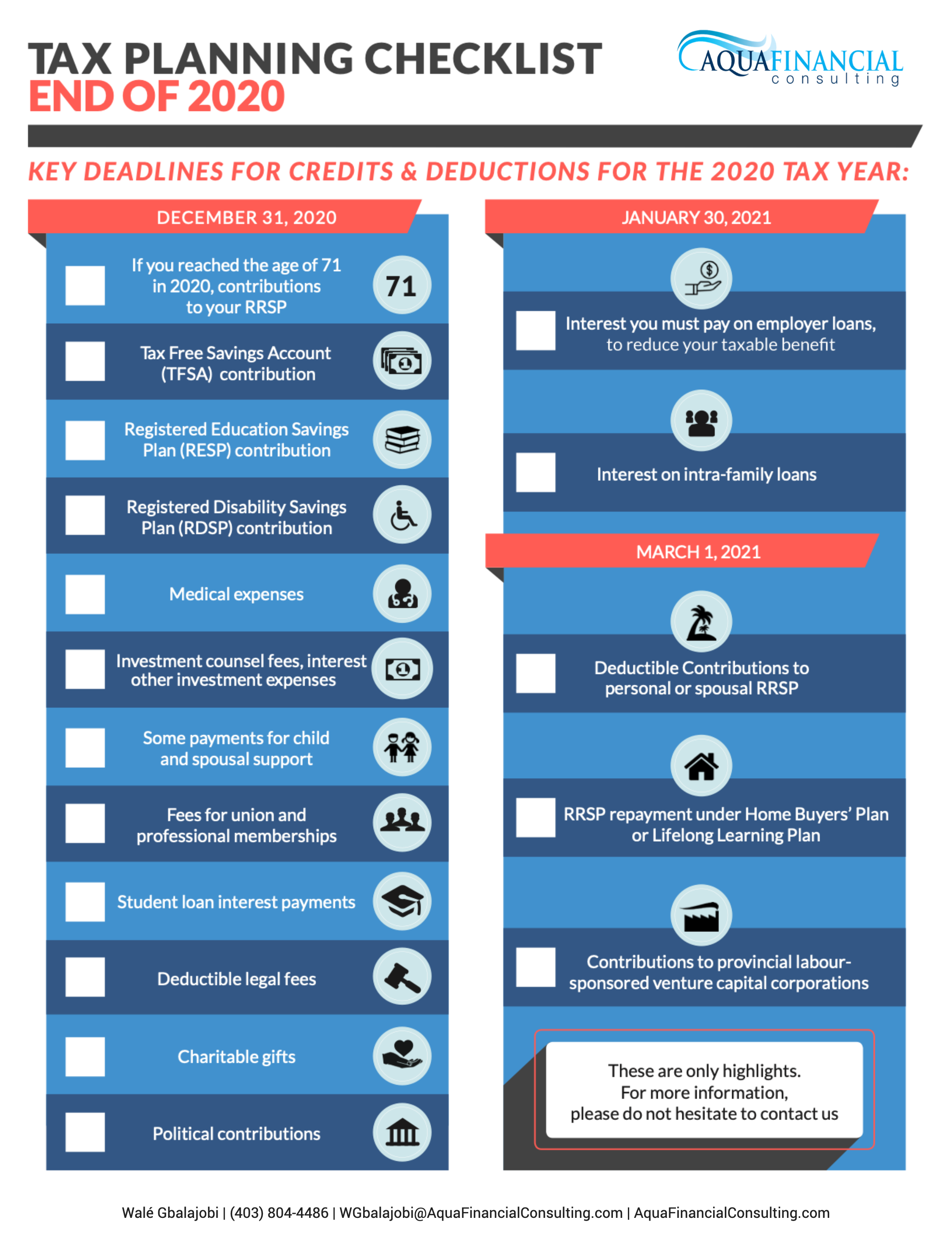
Tax Deadlines for 2020 Savings

December 31, 2020:

  • If you reached the age of 71 in 2020, you can’t contribute to your RRSP after this date

  • Use up your TFSA contribution room

  • Contribute to an RESP to get the Canadian Education Savings Grant (CESG) and the income-tested Canada Learning Bond (if eligible).

  • Contribute to an RDSP to get the Canada Disability Savings Grant (CDSG) and the income-tested Canada Disability Savings Bond (if eligible).

  • Medical expenses

  • Investment counsel fees, interest and other expenses relating to investments

  • Some payments for child and spousal support

  • Fees for union and professional memberships

  • Student loan interest payments

  • Deductible legal fees

  • Charitable gifts

  • Political contributions

January 30, 2021

  • Interest on intra-family loans

  • The interest you must pay on employer loans to reduce your taxable benefit

March 1, 2021

  • Contributions to provincial labour-sponsored venture capital corporations

  • RRSP Repayment under Home Buyers Plan or Lifelong Learning Plan

  • Deductible contributions to a personal or spousal RRSP

Individual Tax Issues

To help Canadians deal with financial hardships due to job loss because of COVID-19, the Canadian government introduced several benefit programs. If you received any of these benefits, you should be aware of the tax ramifications.

The Canada Emergency Response Benefit (CERB) was the first benefit program issued by the government and ran until September 26, 2020. If you received the CERB at all during 2020, the government will issue you at T4A, showing how much money you received from the CERB program. You must then declare that as income when filing your 2020 income tax return. Since no tax was taken off at the source, be sure to put aside money to pay for potential income taxes on your CERB income.

As of September 27, 2020, the government offered three replacement benefit programs:

  • Canada Recovery Benefit (CRB)
    This is for people impacted by COVID-19 who work but are not eligible for EI (e.g. self-employed).

  • Canada Recovery Sickness Benefit (CRSB)
    This is for people who are employed cannot work due to COVID-19 and do not have access to paid sick leave.

  • Canada Recovery Caregiving Benefit (CRCB)
    This is for people who must miss work to care for a family member who has COVID-19.

For all three of these programs, the government will be withholding 10% in taxes upfront, but you may end up owing extra tax, depending on the rest of your income for 2020, so it’s important to set extra money aside for taxes.

Also, there is a unique condition for the CRB only. If you make over $38,000 in 2020 (excluding the CRB), you will have to pay back the CRB at a rate of 50 cents for each dollar of CRB you earned above the threshold.

If you paid interest on an eligible student loan in 2020, you can claim a non-refundable tax credit in the amount of interest you paid by December 31. In addition, you should be aware that student loan payments were frozen for six months – from March 30 to September 30. No interest accrued on student loans during that period.

Family Tax Issues

  • Check your eligibility for the Canada Child Benefit
    (CCB)
    To receive the Canada Child Benefit in 2021/22, you need to file your tax returns for 2020 as the benefit is calculated using your family income from the previous year. Eligibility for the CCB depends on set criteria such as your family’s income, how many children you have, and how old they are. You may qualify for a full or partial amount, depending on whether you have full custody or shared custody.

  • Consider family income splitting

    The CRA offers a prescribed low-interest rate on family loans. Therefore, it makes sense to consider setting up an income splitting loan arrangement with your family members. If you do this, you can potentially lock in a family loan at a low-interest rate of 1% and then invest the borrowed money into a higher return investment while benefitting from your family member’s lower tax status. Don’t forget to adhere to the Tax on Split Income rules.

Managing Your Investments

  • Use up your TFSA contribution room

    If you can, it’s worth contributing the full $6,000 to your TFSA for 2020. You can also contribute more (up to $69,500) if you are 29 or older and haven’t made any previous TFSA contributions.

  • Contribute to a Registered Education Savings Plan (RESP)

    The Registered Education Savings Plan (RESP) is a savings plan for parents and others to save for a child’s education. The Canada Education Savings Grant (CESG) will match up to 20% of your contributions up to a maximum of $2,500.

    That means the CESG can add a maximum of $500 to an RESP each year. The grant room accumulates until your child turns 17. Therefore, any unused CESG amounts for the current year are automatically carried forward for possible use in the future years.

    The income-tested Canada Learning Bond (CLB) is paid directly to a child’s RESP by the Canadian government to low-income families. No personal contributions are required to receive the CLB.

  • Contribute to a Registered Disability Savings Plan (RDSP)

    The Registered Disability Savings Plan (RDSP) is a savings plan for parents and others to save for the financial security of a person who is eligible for the Disability Tax Credit (DTC). The government will pay a matching Canada Disability Savings Grant (CDSG) up to 300% – depending on the beneficiary’s adjusted family net income and amount contributed.

    Also, low-income Canadians with disabilities may be eligible for a Canada Disability Savings Bond (CDSB). If you qualify, it will be paid directly to your RDSP.

    The government will pay matching grants or bonds into the RSDP up to and including the end of the year the recipient turns 49. Be aware that there is a 10-year carry-forward of CDSG and CDSB entitlements.

  • Donate securities to charity

    Donating by year-end will provide you with tax savings. If you donate eligible securities or mutual funds, capital gains tax does not apply, and you can receive a tax receipt for their full market value. Also, the charity gets the full value of the securities.

  • Think about selling any investments with unrealized capital losses

    It might be worth doing this before year-end to apply the loss against any net capital gains achieved during the last three years. The last trading date for 2020 for Canadian and US publicly traded stocks will be Tuesday December 29th in order to record the gain or loss in the 2020 taxation year.

    Conversely, if you have investments with unrealized capital gains that cannot be offset with capital losses, it may be worth selling them after 2020 to be taxed on the income the following year.

  • Consider the timing of purchasing of certain non-registered investments

    Suppose you are considering purchasing an interest-bearing investment like a guaranteed investment certificate (GIC) with a maturity date of one year or more. In that case, you may consider delaying the purchase to the following year, so you don’t have to pay tax on accrued interest until 2021. You should also consider this with mutual funds that make taxable distributions before the end of 2020, consider delaying this until early 2021. Don’t pay taxes earlier than necessary.

  • Check if you have investments in a corporation

    The new passive investment income rules apply to tax years from 2018 onwards. They state that the small business deduction is reduced for companies with between $50,000 and $150,000 of investment income. Therefore, the small business deduction has entirely stopped for corporations that earn a passive investment income of more than $150,000.

    Note – At a provincial level, both Ontario and New Brunswick do not follow the federal rules to limit access to the small business deduction.

Retirement Planning

  • Make the most of your RRSP

    The deadline for making contributions to your RRSP for the year 2020 is March 1, 2021. The deduction limit for 2020 is limited to 18% of the income you earned in 2020, to a maximum of $27,230. This maximum amount is impacted by the following:

  1. Any pension adjustment

  2. Any previous unused RRSP contribution room

  3. Any pension adjustment reversal.

Remember that deducting your RRSP contribution reduces your after-tax cost of making said contribution.

  • Check when your RRSP is due to end

    If you reach the age of 71 during 2020, you must wind up your RRSP this year. You must make your final contribution to it by December 31, 2020.

  • Convert to RRIF before year-end

    If you turned 65 during 2020 or are already older than 65, you’re entitled to a pension credit that can fully or partly offset the tax on the first $2,000 of eligible income annually. Consider setting up an RRIF before year-end to pay out $2,000 annually if you don’t have any other eligible pension income.

If you have any questions about your taxes for 2020, contact us – we can help you!

https://aquafinancialconsulting.com/wp-content/uploads/2020/12/Personal-tax-planning-tips-2020@1000px.png 563 1000 Aquafinancial Consulting https://aquafinancialconsulting.com/wp-content/uploads/2020/04/aqua-logo-revised@2x.png Aquafinancial Consulting2020-12-02 14:07:542020-12-02 15:09:24Personal Tax Planning Tips – End of 2020 Tax Year

Search Blog Posts

Search Search

Latest News

  • Budget 2026: What the New Federal Measures Could Mean for Your MoneyNovember 6, 2026 - 10:51 am
  • How to Catch Up on Your RRSP ContributionsNovember 3, 2026 - 5:51 pm
  • Succession Planning for Business OwnersOctober 6, 2026 - 11:00 am

Categories

  • 2019 Only
  • 2020
  • 2020 Only
  • 2021
  • 2022
  • 2022 Only
  • 2023
  • 2024
  • 2025
  • 2026
  • Accountants
  • Archive
  • Article
  • Blog
  • Budget
  • Business owners
  • Buy Sell
  • Center of Influences
  • Charitable Gifting
  • Coronavirus
  • Coronavirus – associates
  • Coronavirus – practice Owners
  • Coronavirus – Retired
  • Coronavirus – Retiring
  • Coronavirus -students
  • Corporate
  • critical illness insurance
  • Debt
  • dental benefits
  • Disability
  • disability insurance
  • Estate planning
  • Family
  • farmers
  • financial advice
  • financial planning
  • Government Budget
  • group benefits
  • Health benefits
  • incorporated professionals
  • Individuals
  • Insurance
  • Investment
  • Life insurance
  • long term care
  • mortgage
  • Pension plan
  • personal finances
  • Professional Corporations
  • Professionals
  • RDSP
  • Registered Education Savings Plan
  • Retirees
  • Retirement
  • RRSP
  • Tax
  • Tax free savings account
  • travel insurance

Get in Touch

Aquafinancial Consulting
Walé Gbalajobi, BA, FICB, PFP
Financial Advisor
T: (403) 804-4486
aquafina@aquafinancialconsulting.com

3402 8 Street SE
Calgary, AB
T2G 5S7

Book an appointment for an online preliminary online meeting

Latest News

  • Budget 2026: What the New Federal Measures Could Mean for Your MoneyNovember 6, 2026 - 10:51 am
  • How to Catch Up on Your RRSP ContributionsNovember 3, 2026 - 5:51 pm
  • Succession Planning for Business OwnersOctober 6, 2026 - 11:00 am

About

We tailor all our financial consulting services to suit the needs of individual clients. We assign a team of dedicated personnel to work with every client. Our experienced personnel have years of experience in financial consulting making us ideal for all individual and small business financial consulting needs.

Sign up for our newsletter

* indicates required
©2020 Financial Tech Tools Inc. | Privacy Statement and Terms of Use
  • Link to LinkedIn
  • Link to Facebook
  • Link to X
Scroll to top Scroll to top Scroll to top