Aquafinancial Consulting
  • HOME
  • SERVICES
    • INDIVIDUALS & FAMILIES
      • FINANCIAL ADVICE
      • RETIREMENT PLANNING
      • ESTATE PLANNING FOR YOUNG FAMILIES
      • ESTATE PLANNING FOR RETIREES & MATURE FAMILIES
      • INSURANCE PLANNING
    • BUSINESS OWNERS
      • FINANCIAL ADVICE
      • RETIREMENT PLANNING
      • ESTATE PLANNING
      • SUCCESSION PLANNING
      • INSURANCE PLANNING
    • INCORPORATED PROFESSIONALS
      • FINANCIAL ADVICE
      • RETIREMENT PLANNING
    • INSURANCE
      • DISABILITY
      • CRITICAL ILLNESS
      • LIFE
        • PERSONAL
        • CORPORATE
      • HEALTH & DENTAL
      • FOR YOUNG FAMILIES
      • FOR BUSINESS OWNERS
    • INVESTMENT
      • REGISTERED EDUCATION SAVINGS PLAN
      • TAX FREE SAVINGS ACCOUNT
      • REGISTERED RETIREMENT SAVINGS PLAN
      • REGISTERED RETIREMENT INCOME FUND
      • ANNUITIES
    • GROUP BENEFITS
      • HEALTH BENEFITS
      • RETIREMENT BENEFITS
  • ABOUT
    • ABOUT
    • SUPPLIERS
    • PRIVACY & WEBSITE TERMS OF USE
  • NEWS
  • EVENTS
  • CONTACT
  • Click to open the search input field Click to open the search input field Search
  • Menu Menu
  • Link to LinkedIn
  • Link to Facebook
  • Link to X

Archive for category: Investment

How to Catch Up on Your RRSP Contributions

November 3, 2026/in 2026, Blog, Investment, Retirement/by Aquafinancial Consulting

How to Catch Up on Your RRSP Contributions

If you have ever felt behind on your RRSP, you are not alone. Life gets in the way, rent, a mortgage, kids, a period of lower income, and RRSP contributions get pushed to the back of the list.

Here is the good news: unused RRSP contribution room does not disappear. It accumulates year over year, and many Canadians are sitting on far more room than they realize. Catching up on those contributions is one of the most straightforward ways to reduce your tax bill.

Here is how it works.

What Is RRSP Contribution Room?

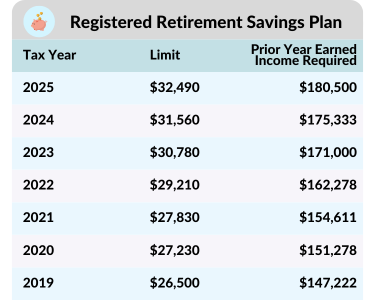
Each year, the Canada Revenue Agency (CRA) calculates how much you are allowed to contribute to your RRSP. The formula is 18% of your prior year’s earned income, up to an annual maximum set by the government, which is updated periodically and published by the CRA each year.

If you do not contribute the full amount in a given year, the unused room carries forward to the following year. And the year after that. And so on.

This carry-forward provision is what makes catch-up contributions possible. Someone who has been contributing inconsistently over the past decade may have accumulated tens of thousands of dollars in available room.

How to Find Your Contribution Room

The most reliable way to see your available RRSP room is through your CRA My Account, the federal government’s online portal. Once logged in, look for your Notice of Assessment (NOA) from last year’s tax return. Your RRSP deduction limit for the current year is listed there explicitly.

If you have not set up a CRA My Account, the same information appears on the paper NOA mailed to you after your return is processed. You can also call the CRA directly to confirm your available room.

Your available room is the combined total of any room you did not use in prior years, plus the new room added based on last year’s income.

The Tax Benefit of Catching Up

RRSP contributions reduce your taxable income dollar for dollar. If you are in a 40% combined federal and provincial marginal tax bracket and contribute $10,000 to your RRSP, you reduce your taxable income by $10,000, which means approximately $4,000 less in taxes owed.

That is the core value of catching up. Every dollar of unused room you do not use is a tax deduction sitting on the table.

The benefit compounds over time as well. Money contributed to your RRSP grows tax-sheltered until withdrawn. The earlier it is contributed, the longer it has to grow without being taxed each year.

The RRSP Catch-Up Loan Strategy

One approach many Canadians use is an RRSP catch-up loan, a short-term personal loan taken specifically to make a large RRSP contribution all at once.

Here is the idea: you borrow a lump sum, deposit it into your RRSP before the deadline, and use the tax refund you receive to pay down a significant portion of the loan. If your refund covers half the loan, for example, you are left with only half the balance to pay off over the following months.

This strategy works best when:

  • You have a meaningful amount of carry-forward room built up
  • You are in a higher tax bracket, which produces a larger refund
  • You can realistically pay off the loan within 12 months

The interest on an RRSP loan is not tax-deductible, so the goal is to repay it quickly. Holding the loan for an extended period reduces the overall benefit of the strategy.

Many Canadian banks and credit unions offer RRSP loans specifically for this purpose, often at competitive rates and with repayment terms designed around the expected tax refund timeline.

Timing: The RRSP Deadline

RRSP contributions for a given tax year must be made by 60 days after December 31, which works out to March 1 in most years, or March 2 when the following year is a leap year. Contributions made in January or February of the new year can be applied to either the previous tax year or the current one, giving you some flexibility.

Many Canadians wait until close to the deadline to contribute. While this is common, making contributions earlier in the year, or throughout the year, means the money spends more time growing inside the plan.

Over-Contributing: What to Watch

There is one important guard rail: RRSP over-contributions above a $2,000 lifetime buffer are penalized at 1% per month on the excess amount. This rarely happens accidentally, but it is worth confirming your available room before making a large lump-sum deposit.

Your confirmed room from your most recent NOA, minus any contributions already made in the current year, gives you your remaining available room.

When an RRSP Makes the Most Sense

The RRSP is most valuable when you are in a higher tax bracket now than you expect to be in retirement. Contributing while earning at a high rate and withdrawing at a lower rate in retirement produces the greatest tax advantage.

If you are in a lower bracket now, it can sometimes make more sense to contribute to a TFSA first and save your RRSP room for higher-earning years. Both accounts have their place, and many Canadians use both, the RRSP for the tax deduction today, the TFSA for tax-free access later.

Putting It Together

If you have years of unused RRSP room, that room represents real tax savings that are still within reach. Catching up does not require a windfall. It can be done gradually, contributing more each year than required, or all at once using a short-term loan.


Check your CRA My Account for your current room, run the numbers on what a contribution would mean for your tax return this year, and decide whether catching up makes sense for your situation. The deadline comes every early March, and with every year that passes, the carry-forward room keeps growing.

This content is provided for general informational purposes only. It is not intended to provide investment, tax, or legal advice, and should not be relied upon as such.

Sources:

  • RRSP Contributions – Government of Canada
  • My CRA Account – Government of Canada

https://aquafinancialconsulting.com/wp-content/uploads/2026/11/How-to-Catch-Up-on-Your-RRSP-Contributions.png 700 1200 Aquafinancial Consulting https://aquafinancialconsulting.com/wp-content/uploads/2020/04/aqua-logo-revised@2x.png Aquafinancial Consulting2026-11-03 17:51:272026-11-03 17:51:39How to Catch Up on Your RRSP Contributions

Financial Checklist for New Parents in Canada

June 30, 2026/in Blog, Insurance, Investment/by Aquafinancial Consulting

What to Do Financially When You Have a Baby

A new baby brings a lot of joy, and a lot of new to-do lists. Most of them are about feeding schedules and car seats. But a few items on the list are about money, and they matter more than you might think.

You do not need to do everything at once. A newborn keeps you busy enough. The steps below can be spread out over the first few months. Think of this as a simple checklist you can come back to as you find the time and energy.

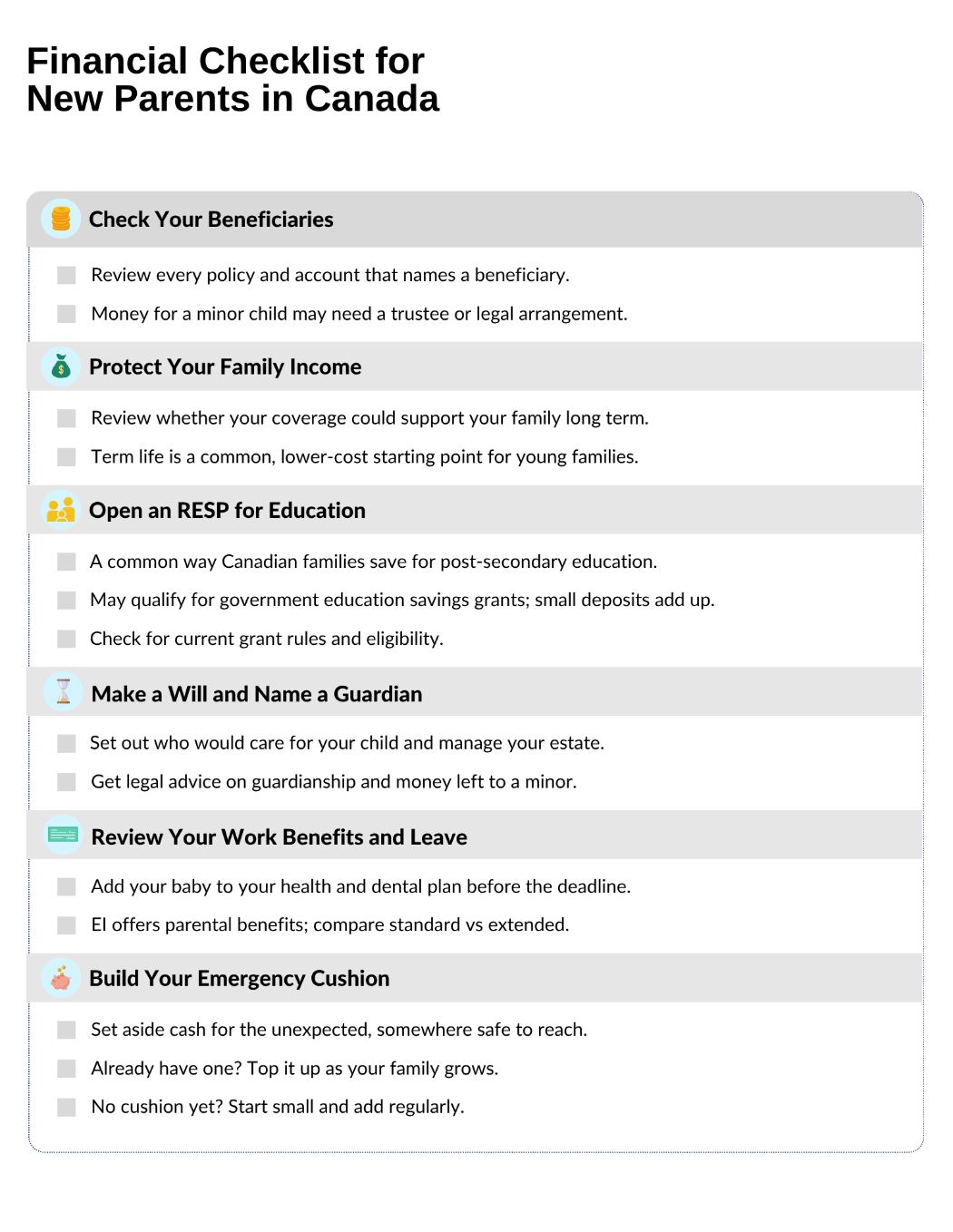
Check Your Beneficiaries

A beneficiary is the person who receives the money from your life insurance or certain registered accounts after you pass away. Many people set these up years ago and never look at them again.

Now is a good time to check. You may want to add your partner, update an older choice, or think through how money should be handled for your child. If you want money to go to a minor child, it may need to be managed through a trustee or other legal arrangement until the child is of age, depending on the asset and the province.

The key point is simple. Look at every policy and account that names a beneficiary, and make sure the names and instructions still match the life you have today.

Protect Your Family Income With Life Insurance

When it was just you, or just you and your partner, a gap in income may have been easier to manage. With a baby who depends on you, the stakes are higher. Life insurance can help protect your family financially if something happens to you, so they can keep up with housing costs, bills, and daily expenses.

For many young families, term life insurance is a common starting point. It covers you for a set number of years, often when your children are young and your financial obligations are highest. The premiums are usually lower than permanent coverage, which can make it easier to fit into a new-parent budget.

Your need for coverage often increases when you have a child. It is worth checking whether your current coverage, including any through work, would be enough to support your family for more than just the short term.

brandableContent

Open an RESP for Education

A Registered Education Savings Plan, or RESP, is a common way Canadian families save for a child’s post-secondary education. One reason many parents use it is the government support that can come with it through education savings grants.

You do not need a large amount to begin. Even small, regular deposits can add up over time. Check canada.ca for the current grant rules, contribution details, and eligibility requirements.

Make a Will and Name a Guardian

This is the step many new parents put off, and it is one of the most important. A will helps set out who would care for your child and how your estate should be handled if you and your partner die.

For parents, the most important part is often naming the person you want to care for your child. In BC, a will can express your wishes about guardianship, but it is also important to work with proper legal advice so your will deals clearly with both the care of your child and the management of any money left to a minor.

If you already have a will, a new baby is a good reason to review it. Add your child, confirm your choices, and make sure your estate plan still reflects your wishes.

Review Your Work Benefits and Leave

Your job may offer more help than you realize. Many group benefit plans allow you to add a new dependent, but the deadline depends on the plan. Check with your human resources team or plan administrator as soon as possible after the birth so you do not miss the deadline for health and dental coverage.

Employment Insurance, or EI, also offers maternity and parental benefits for eligible parents. Parents can choose standard or extended parental benefits, and the timing and number of weeks differ between the two options, so it is important to review the current rules before applying.

Build Your Emergency Cushion

A baby comes with surprises, and some of them cost money. An emergency cushion is simply cash set aside for the unexpected, kept somewhere safe and easy to reach.

If you already have one, this is a good time to top it up. A larger family often means larger surprise costs. If you do not have one yet, start small. Even a modest amount set aside regularly can help keep a rough week from becoming a money crisis.

A Calm Way to Start

That is a full list, and you do not have to tackle it all at once. Pick one item this week. Maybe it is checking a beneficiary, or asking work about adding your baby to your benefits. Small steps, taken one at a time, can help build a stronger financial foundation for your growing family.

This content is provided for general informational purposes only. It is not intended to provide investment, tax, or legal advice, and should not be relied upon as such.

Sources:
  • Registered Education Savings Plan (RESP) – Government of Canada

  • Canada Education Savings Grant (CESG) – Government of Canada

  • EI Maternity and Parental Benefits – Government of Canada

  • Making a Will and Power of Attorney – Government of Canada

https://aquafinancialconsulting.com/wp-content/uploads/2026/06/Financial-Checklist-for-New-Parents-FI.png 700 1200 Aquafinancial Consulting https://aquafinancialconsulting.com/wp-content/uploads/2020/04/aqua-logo-revised@2x.png Aquafinancial Consulting2026-06-30 16:13:312026-06-30 16:14:09Financial Checklist for New Parents in Canada

Tax-Free Savings Account vs Registered Retirement Savings Plan

February 2, 2026/in 2026, Blog, Investment, RRSP, Tax free savings account/by Aquafinancial Consulting

Tax-Free Savings Account vs Registered Retirement Savings Plan

When it comes to saving in a tax-efficient way, Canadians often ask the same question: Should I use a TFSA or an RRSP?

Both accounts offer valuable tax advantages, but they work differently — and the “right” choice depends on your income, goals, and how you expect to use the money in the future. As advisors, we often help clients understand not just how these accounts work, but how to use them strategically together.

Below, we break down the key differences between TFSAs and RRSPs, focusing on how contributions and withdrawals work — and how those differences can shape your overall plan.

TFSA vs RRSP: Differences in Contributions

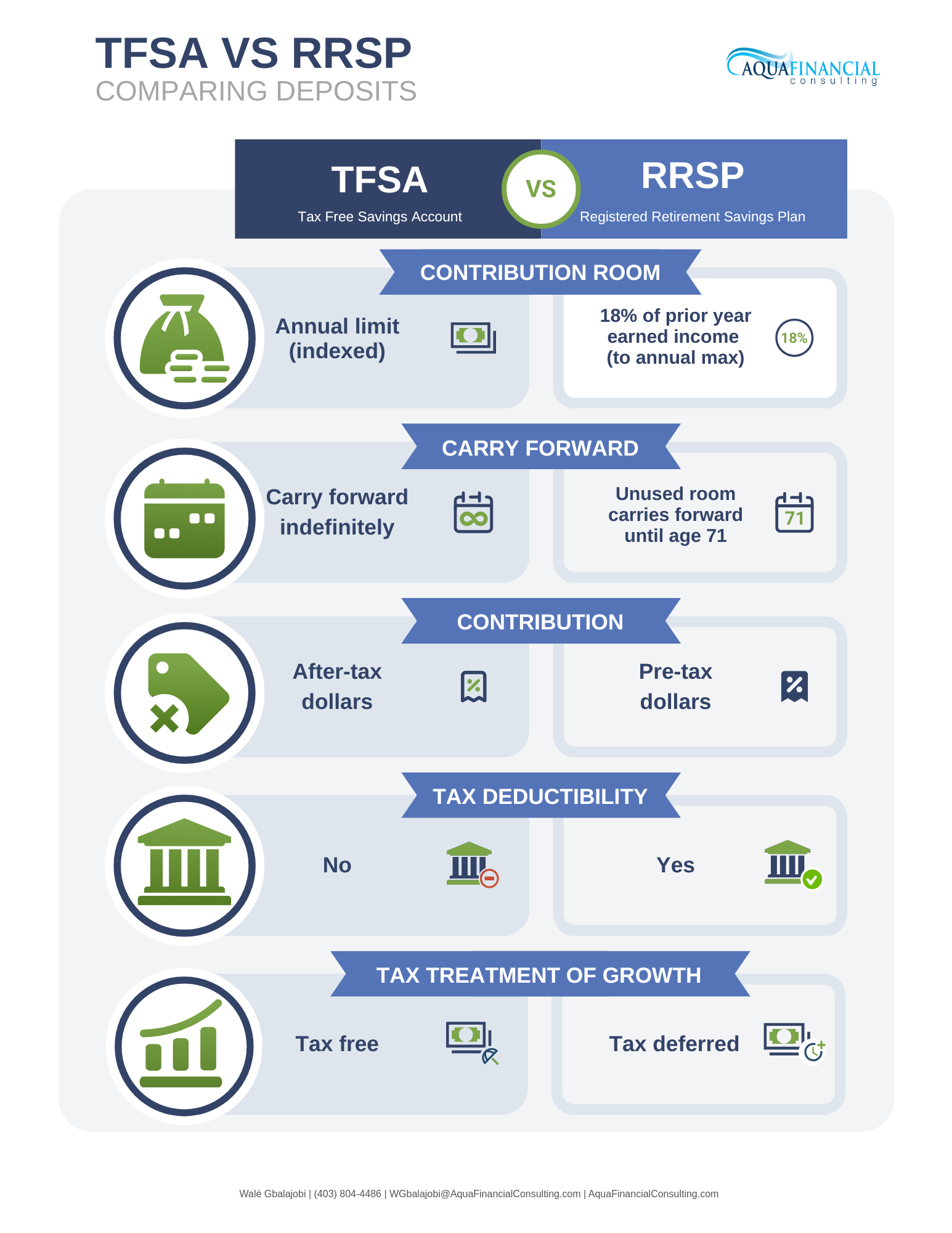
When comparing how TFSAs and RRSPs work on the contribution side, there are four main factors we look at with clients:

  • Contribution room
  • Carry forward rules
  • Tax deductibility
  • Tax treatment of growth
brandableContent

How much contribution room do you have?

TFSA

Your TFSA contribution room is based on an annual limit set by the federal government, which is indexed and may change over time. If you don’t use your full TFSA room in a given year, the unused amount carries forward and continues to accumulate as long as you’re eligible.

This makes the TFSA especially flexible for people who contribute irregularly or who want to prioritize liquidity.

RRSP

RRSP contribution room is based on your income. Each year, you can contribute up to 18% of your earned income from the prior year, up to an annual maximum set by the Canada Revenue Agency.

Because RRSP room depends on income, contribution limits will naturally vary from person to person.

Can unused contribution room be carried forward?

Yes — for both accounts, but with different rules.

TFSA

Unused TFSA contribution room can be carried forward indefinitely. If you make a withdrawal, the amount withdrawn is added back to your available contribution room in the following calendar year.

RRSP

Unused RRSP contribution room can also be carried forward, but only until the year you turn 71. At that point, your RRSP must be converted to a Registered Retirement Income Fund (RRIF) or another qualifying option. Withdrawals from an RRSP do not create new contribution room.

Are contributions tax-deductible?

This is one of the most important distinctions.

  • TFSA contributions are made with after-tax dollars and are not tax-deductible.
  • RRSP contributions are made with pre-tax dollars and are tax-deductible, which can reduce your taxable income in the year you contribute.

How is investment growth taxed?

  • TFSA growth is completely tax-free. You don’t pay tax on interest, dividends, capital gains, or withdrawals.
  • RRSP growth is tax-deferred. Investments can grow without tax while they remain inside the plan, but withdrawals are taxable when taken.

This difference plays a major role in how each account is used within a broader financial strategy.

TFSA vs RRSP: Differences in Withdrawals

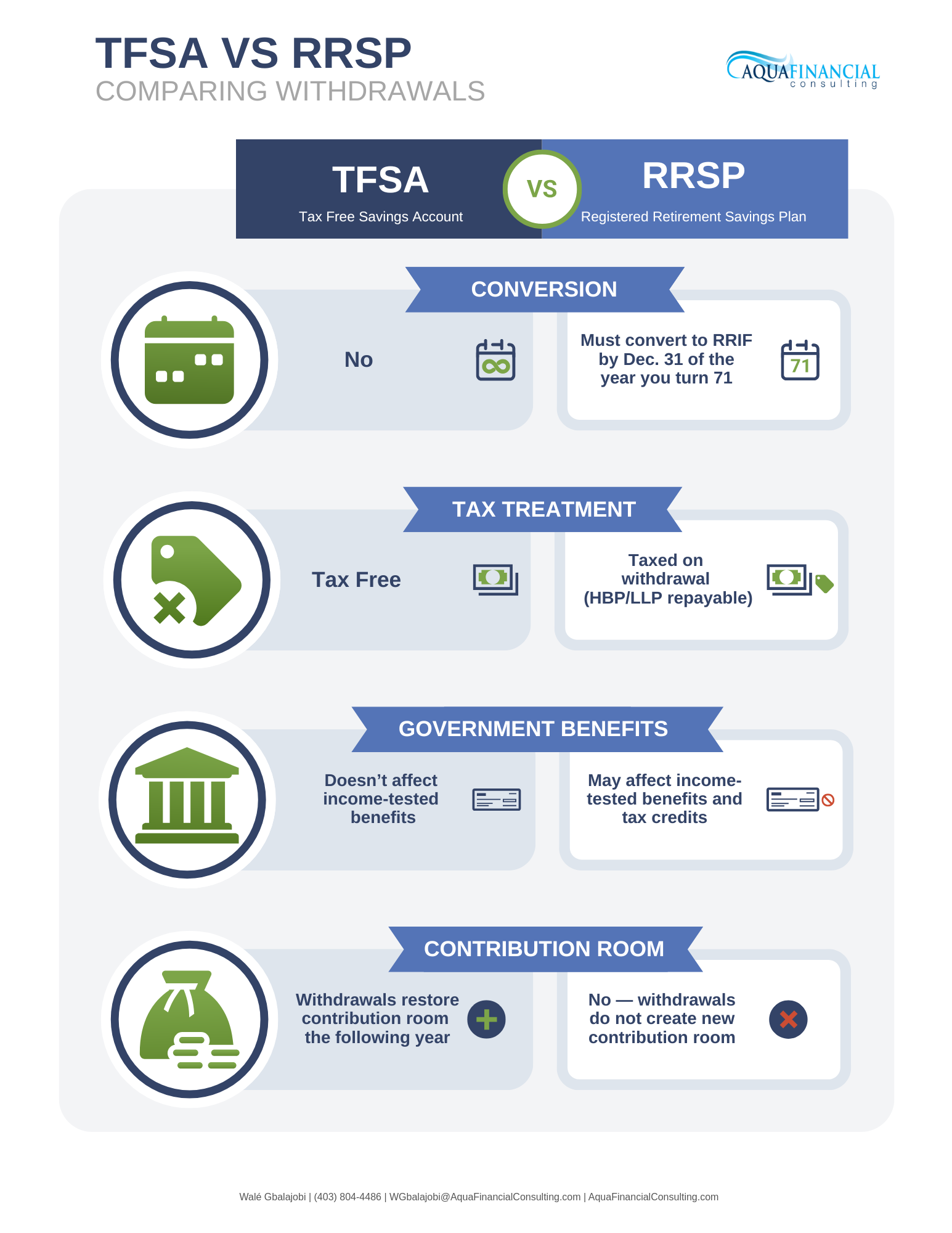
Understanding how withdrawals work is just as important as understanding contributions. When we help clients evaluate withdrawals, we focus on:

  • Conversion requirements
  • Tax treatment
  • Impact on government benefits
  • Effect on future contribution room
brandableContent

Are there conversion requirements?

TFSA

There are no conversion requirements for a TFSA. You can hold and use a TFSA at any age.

RRSP

An RRSP must be converted to a RRIF (or similar option) by December 31 of the year you turn 71. After conversion, minimum annual withdrawals are required.

How are withdrawals taxed?

TFSA

All TFSA withdrawals are tax-free, regardless of when or why the money is withdrawn.

RRSP

RRSP withdrawals are taxed as income in the year they’re taken.

There are two commonly used programs that allow temporary RRSP withdrawals:

  • The Home Buyers’ Plan (HBP)
  • The Lifelong Learning Plan (LLP)

Withdrawals under these programs are not taxed at the time of withdrawal, provided they are repaid according to the program rules. If they are not repaid, the amounts become taxable income.

How do withdrawals affect government benefits?

This is an area we pay close attention to when planning withdrawals.

  • TFSA withdrawals do not count as taxable income and generally do not affect income-tested government benefits.
  • RRSP (and RRIF) withdrawals are taxable and may affect income-tested benefits and tax credits, depending on your total income.

This distinction often makes TFSAs particularly valuable later in life or during years when benefit eligibility matters.

Do withdrawals create new contribution room?

  • TFSA: Withdrawals restore contribution room in the following calendar year.
  • RRSP: Withdrawals do not create new contribution room.

How advisors typically help clients choose

In practice, the decision isn’t usually TFSA or RRSP — it’s how and when to use each.

We often consider:

  • Current vs future tax rates
  • Income stability
  • Access to employer pension plans
  • Government benefits today or later
  • Short-term flexibility vs long-term tax deferral

Used thoughtfully, both accounts can play an important role in a well-structured plan.

TFSAs and RRSPs are both powerful savings tools, but they’re designed to solve different problems. Understanding how they work — and how they interact with your income, taxes, and benefits — can make a meaningful difference over time.

If you’d like help determining how a TFSA, RRSP, or a combination of both fits into your overall strategy, we’re happy to walk through your options with you.

Sources:

Canada Revenue Agency. Registered Retirement Savings Plan (RRSP). Government of Canada, https://www.canada.ca/en/revenue-agency/services/tax/individuals/topics/rrsps-related-plans/registered-retirement-savings-plan-rrsp.html

Canada Revenue Agency. Tax-Free Savings Account (TFSA). Government of Canada, https://www.canada.ca/en/revenue-agency/services/tax/individuals/topics/tax-free-savings-account.html

https://aquafinancialconsulting.com/wp-content/uploads/2026/02/TFSA-vs-RRSP-FI.png 700 1200 Aquafinancial Consulting https://aquafinancialconsulting.com/wp-content/uploads/2020/04/aqua-logo-revised@2x.png Aquafinancial Consulting2026-02-02 13:31:302026-02-02 13:31:43Tax-Free Savings Account vs Registered Retirement Savings Plan

2025 Federal Budget Highlights

November 5, 2025/in 2025, Blog, Business owners, Estate planning, Family, financial planning, incorporated professionals, Individuals, Investment, mortgage, personal finances, Professional Corporations, Professionals, Retirees, Retirement, Tax/by Aquafinancial Consulting

2025 Federal Budget Highlights

On November 4, 2025, the budget was delivered by the Honourable François-Philippe Champagne, Minister of Finance and National Revenue.

The 2025 Federal Budget focuses on stability, simplicity, and long-term growth. There are no broad tax increases or major new spending programs. Instead, the government is emphasizing restraint, modernization, and productivity.

For individuals and business owners, the goal is clear: help Canadians access benefits more easily, encourage investment in innovation and clean energy, and update trust and estate rules to maintain fairness across the system.

Economic Overview

Canada’s federal deficit is projected at $78.3 billion for 2025–26. The government aims to stabilize the debt-to-GDP ratio while maintaining funding for priorities such as housing, defence, and clean energy.

Spending will focus on programs that improve productivity, while efficiency reviews across departments are expected to reduce overlap and administrative costs. This marks a shift toward sustainable fiscal management and practical, targeted investments.

Personal and Family Tax Measures

Several measures are designed to make life more affordable, particularly for first-time home buyers, caregivers, and lower-income households.

Eliminating the GST for First-Time Home Buyers

First-time home buyers will not pay the 5 percent federal GST on new homes priced up to $1 million. For new homes between $1 million and $1.5 million, a partial GST reduction applies. This change provides meaningful savings and makes new construction more accessible for Canadians entering the housing market.

Home Accessibility Tax Credit

Starting in 2026, expenses can no longer be claimed under both the Home Accessibility Tax Credit and the Medical Expense Tax Credit. The rule prevents duplicate claims but continues to support renovations that make homes safer and more accessible for seniors or individuals with disabilities.

Top-Up Tax Credit

To balance the reduction in the lowest federal tax bracket—from 15 percent to 14.5 percent in 2025, and 14 percent in 2026—the government introduced a Top-Up Tax Credit to preserve the value of non-refundable credits such as tuition, medical, and charitable amounts. This temporary measure, available from 2025 through 2030, ensures Canadians receive the same credit value even as rates decrease.

Personal Support Workers (PSW) Tax Credit

A new refundable tax credit equal to 5 percent of eligible income, up to $1,100 per year, will be available for certified personal support workers beginning in 2026. The measure acknowledges the importance of care professionals and provides direct relief to those in long-term and community-care roles.

Automatic Federal Benefits

Starting in 2025, the Canada Revenue Agency will begin automatically filing simple tax returns for eligible Canadians who do not normally file. This will allow low-income earners and seniors to receive benefits such as the Canada Workers Benefit, GST/HST Credit, and Canada Carbon Rebate automatically. Those with more complex financial situations will continue to file regular returns.

Registered Plans, Trusts, and Estate Planning

The budget introduces several changes affecting trusts and registered plans—key tools in long-term financial and estate planning.

Bare Trust Reporting Rules

Implementation of new bare trust reporting requirements has been delayed. The rules will now apply to taxation years ending December 31, 2026, or later. This postponement gives individuals, trustees, and professionals more time to prepare for the new filing obligations.

The 21-Year Rule for Trusts

Trusts—particularly most personal or family trusts—are generally considered to have sold and repurchased their capital property every 21 years (a “deemed disposition”). This rule prevents indefinite deferral of capital-gains tax on assets that grow in value.

When property is moved on a tax-deferred basis from one trust to another, the receiving trust normally inherits the original 21-year anniversary date so that tax timing does not reset.

Some estate-planning arrangements have transferred trust property indirectly—for example, through a corporation or a beneficiary connected to a second trust—so that the transfer did not appear to be trust-to-trust. These arrangements effectively extended the period before capital gains would be recognized.

Budget 2025 broadens the anti-avoidance rule to include indirect transfers. Any transfer of property made on or after November 4, 2025, that effectively moves assets from one trust to another will retain the original 21-year schedule.

For families that use trusts in estate or business-succession planning, this change reinforces the importance of reviewing structure and timing. Trusts remain valuable for asset protection, legacy planning, and income distribution—this update simply ensures consistent application of the 21-year rule.

Qualified Investments for Registered Plans

Beginning January 1, 2027, all registered plans—RRSPs, TFSAs, FHSAs, RDSPs, and RESPs—will follow a single harmonized list of qualified investments. Small-business shares will no longer qualify for new contributions, though existing holdings will remain grandfathered. The update simplifies compliance and clarifies which assets can be held in registered accounts.

Business and Investment Incentives

For business owners, Budget 2025 provides opportunities to reinvest, innovate, and modernize operations, with emphasis on manufacturing, research, and clean technology.

Immediate Expensing for Manufacturing and Processing Buildings

Businesses can now claim a 100 percent deduction for eligible manufacturing and processing buildings acquired after Budget Day and available for use before 2030. This full write-off improves cash flow and encourages earlier expansion. The benefit will gradually phase out after 2033.

Scientific Research and Experimental Development (SR&ED)

The refundable SR&ED tax credit limit has increased from $3 million to $6 million per year, effective for taxation years beginning after December 16, 2024. This expansion strengthens support for small and medium-sized Canadian businesses investing in innovation and technology.

Tax Deferral Through Tiered Corporate Structures

To prevent deferrals of tax on investment income, new rules will suspend dividend refunds for affiliated corporations with mismatched fiscal year-ends. This ensures consistent taxation within corporate groups and aligns refund timing with income recognition.

Agricultural Co-operatives

The tax deferral for patronage dividends paid in shares has been extended to December 31, 2030, continuing to support agricultural co-operatives and their members.

Clean Technology and Clean Electricity Investment Credits

Clean-technology and clean-electricity incentives have been expanded to include additional critical minerals—such as antimony, gallium, germanium, indium, and scandium—used in advanced manufacturing and renewable energy production. The Canada Growth Fund can now invest in qualifying projects without reducing the amount of credit companies can claim, keeping the incentive structure attractive for green investment.

Canadian Entrepreneurs’ Incentive

The government has confirmed it will not proceed with the previously proposed Canadian Entrepreneurs’ Incentive. The existing Lifetime Capital Gains Exemption remains unchanged and continues to apply to the sale of qualified small-business shares.

Tax Simplification and Repealed Measures

To simplify administration and reduce complexity, two taxes are being repealed:

– Underused Housing Tax, beginning in 2025

– Luxury Tax on aircraft and vessels for purchases made after November 4, 2025

In addition, the Canada Carbon Rebate will issue its final household payment in April 2025, with no rebates available for returns filed after October 30, 2026. These changes are meant to streamline compliance and eliminate programs that were costly to administer.

Government Direction and Spending Priorities

Beyond taxation, the budget sets out the government’s broader policy priorities.

Downsizing Government: A comprehensive efficiency review is underway to eliminate duplication across departments and generate long-term savings.

Cuts to Immigration: To ease pressure on housing and infrastructure, temporary-resident levels will be reduced by about 20 percent over two years, while maintaining pathways for essential workers.

Defence Spending: Canada will invest an additional $7 billion over five years to strengthen NATO participation, Arctic defence, and cybersecurity. By 2030, defence spending is expected to reach 1.8 percent of GDP.

Oil and Gas Emission Cap: A phased-in cap starting in 2026 will allow companies to meet targets through carbon-capture and clean-tech investments rather than penalties.

Final Thoughts

For individuals, the most relevant updates include GST relief for first-time home buyers, improved benefit access, and continued tax relief for caregivers and support workers. For business owners, the focus remains on productivity—through immediate expensing, expanded SR&ED credits, and clean-tech investment incentives. For families using trusts or inter-generational structures, the clarified 21-year rule reinforces transparency in estate planning.

If you’d like to review what these changes mean for you or your business, please get in touch. We can look at your goals and make sure you’re well prepared for the year ahead.

https://aquafinancialconsulting.com/wp-content/uploads/2025/11/Federal-Budget-2025.png 700 1200 Aquafinancial Consulting https://aquafinancialconsulting.com/wp-content/uploads/2020/04/aqua-logo-revised@2x.png Aquafinancial Consulting2025-11-05 12:32:062025-11-05 12:32:192025 Federal Budget Highlights

OAS Clawback 2025: What Retirees Need to Know About the Recovery Tax

July 3, 2025/in 2025, Blog, Investment, Pension plan, Retirees, Retirement/by Aquafinancial Consulting

OAS Clawback 2025

If you’ve worked hard to build your retirement income, the last thing you want is to see your government benefits clawed back. Yet for many Canadians, the Old Age Security (OAS) recovery tax—commonly called the OAS clawback—can quietly reduce this valuable benefit.

Here’s how the recovery tax works in 2025, what happens if you delay OAS to age 70, and the strategies we use to help our clients minimize or avoid the clawback.

What is the OAS Recovery Tax?

OAS is a monthly benefit available to most Canadians aged 65 and older. However, once your income exceeds a certain level, the government recovers part or all of your OAS through the recovery tax.

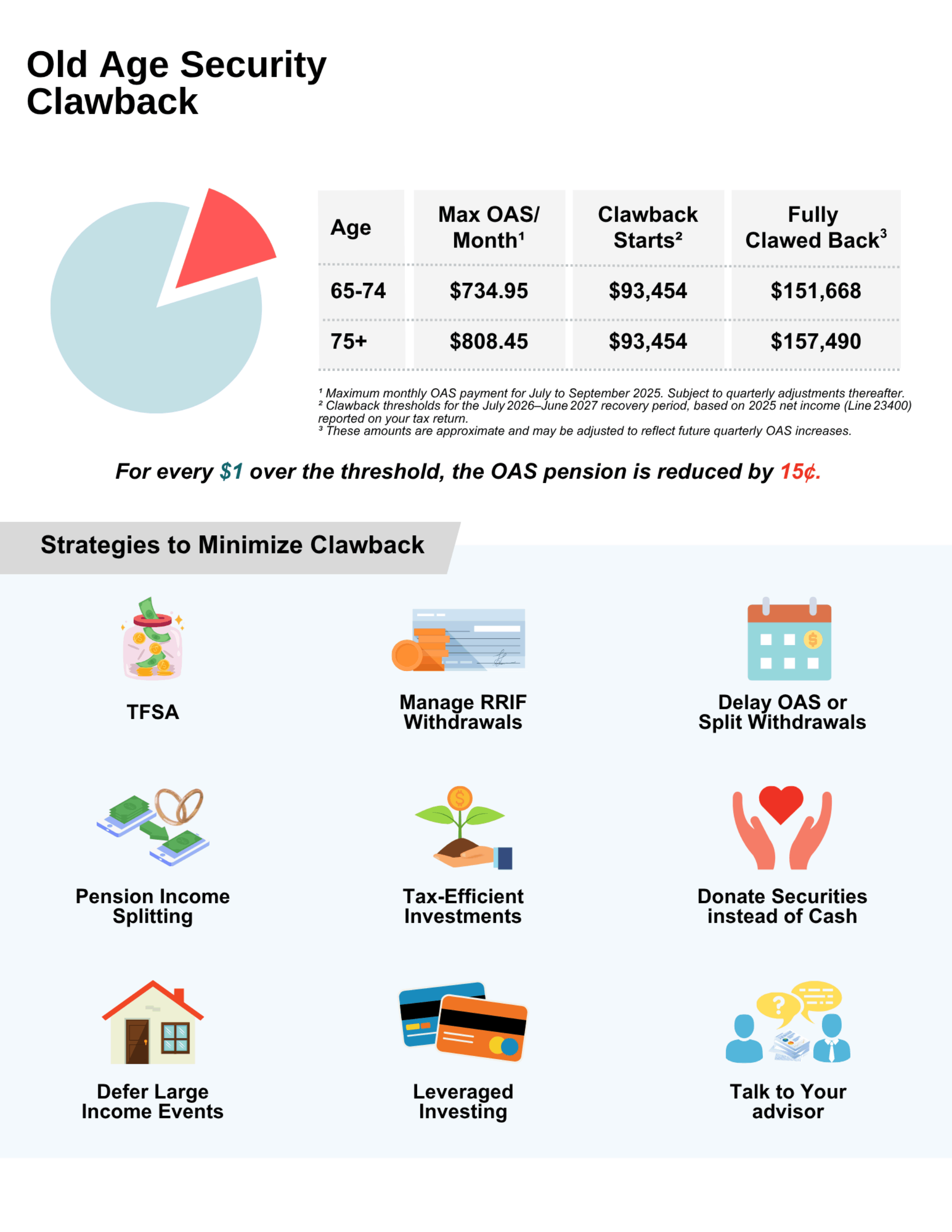
This is calculated based on Line 23400 of your tax return—net income before adjustments. In 2025, the clawback begins when your income exceeds $93,454. For every dollar above that amount, you must repay 15 cents of your OAS.

If your income reaches approximately $151,668 (age 65–74) or $157,490 (age 75+), you could lose your entire OAS benefit for the year.

How Much is the OAS Benefit in 2025?

From July through September 2025, the maximum monthly OAS payment is:

  • $734.95 for individuals aged 65–74 (about $8,820 annually)

  • $808.45 for individuals aged 75+ (reflecting a 10% enhancement introduced in 2022)

These amounts are indexed quarterly to inflation and are subject to clawback if your Line 23400 income exceeds the threshold.

What Happens if You Delay OAS Until 70?

You can choose to delay receiving OAS up to age 70, increasing your monthly benefit by 0.6% for each month deferred—a total boost of up to 36% if you wait the full five years.

While a higher payment may sound appealing, it can also lead to larger OAS repayments if your income—including CPP, investment returns, or pension income—exceeds the recovery threshold. Delaying OAS often makes sense for healthy individuals who expect to live into their late 80s or beyond and have lower taxable income during the deferral period.

How the OAS Recovery Tax Works

Example: Alan is 68 and receives the maximum OAS: $8,820 annually. In 2025, the clawback threshold begins at $93,454. Alan’s line 23400 income is $100,000—that’s $6,546 over the clawback threshold. As a result, he must repay: $6,546 × 15% = $981.90

This leaves Alan with $7,838.10 in OAS benefits for the year. If he earns more, the repayment increases proportionally. Once Alan’s income reaches around $151,668 (if aged 65–74) or $157,490 (if aged 75+), his entire OAS would be clawed back.

The recovery tax calculation is automatic and appears on your Notice of Assessment each spring, adjusting your OAS payments for the following July–June period.

brandableContent

Strategies to Reduce or Avoid the OAS Clawback

The good news? There are practical ways to lower your Line 23400 income without compromising your lifestyle. Here are some of the strategies we use to help our clients keep more of their benefits:

Use a TFSA for Retirement Income

Withdrawals from a Tax-Free Savings Account (TFSA) don’t count toward Line 23400. Drawing income from a TFSA instead of taxable accounts can help preserve your OAS and reduce your tax burden.

Manage RRIF Withdrawals

RRIF withdrawals are fully taxable and included in Line 23400. If you don’t need the full minimum withdrawal, we may recommend delaying full RRSP-to-RRIF conversion or converting just part each year starting at age 65. This can help smooth your income and avoid large spikes.

Delay OAS or Split Withdrawals Over Time

If you’re planning to delay OAS, we’ll help ensure you’re not unintentionally stacking income in the deferral years. Likewise, we can help you spread RRSP-to-RRIF conversions over several years to avoid unnecessary spikes in income.

Pension Income Splitting

If you’re married or in a common-law relationship, you can split up to 50% of eligible pension income with your spouse. This reduces your taxable income and can keep you below the clawback threshold—especially effective when one spouse earns significantly less.

Choose Tax-Efficient Investments

Not all investment income is taxed equally:

  • Capital gains: 50% taxable; more clawback-friendly

  • Eligible dividends: grossed up for Line 23400 purposes, potentially triggering more clawback despite the tax credit

  • Interest income: fully taxable and the least efficient for minimizing clawback

We can help structure your investments to be as clawback-friendly as possible.

Donate Securities Instead of Cash

Donating appreciated publicly traded securities directly to a registered charity eliminates the capital gains tax, reduces net income, and supports a cause—all while lowering recovery tax exposure.

Defer Large Income Events

Selling a property, realizing a large capital gain, or cashing a pension lump sum can push you into full clawback territory. If possible, we can help you plan these events to spread them over several years or delay them to a lower-income year.

Consider Leveraged Investing

Some higher-net-worth clients use leveraged investment strategies—borrowing to invest in tax-efficient, capital-gains-producing assets. Interest may be deductible, and investment income can be structured to reduce Line 23400. This is a high-risk strategy and something we’ll discuss carefully if appropriate.

Talk to Your Financial Advisor

Everyone’s income, retirement timing, and tax situation are unique. That’s why we take the time to understand your goals, project your Line 23400 income, explore different scenarios, and build a personalized strategy designed to minimize the recovery tax while keeping your lifestyle in mind.

The OAS recovery tax can quietly chip away at your retirement income—but it doesn’t have to. With the right guidance and a plan tailored to you, it’s possible to keep more of what you’ve worked so hard to earn.

If you’re already retired or approaching retirement, now is the perfect time to sit down and talk. Together, we’ll review where you stand, explore your options, and build a strategy that keeps more of your income working for you. We’re here to help you make the most of your retirement—let’s get started.

Disclaimer: This article is for informational purposes only and does not constitute financial, legal, or tax advice. Always consult a qualified professional regarding your specific situation. We are not responsible for any actions taken based on this content.

Sources: Old Age Security Payment Amount – Government of Canada: https://www.canada.ca/en/services/benefits/publicpensions/old-age-security.html

Old Age Security Pension Recovery Tax– Government of Canada: https://www.canada.ca/en/services/benefits/publicpensions/old-age-security/recovery-tax.html 

https://aquafinancialconsulting.com/wp-content/uploads/2025/07/OAS-ClawbackFI.png 700 1200 Aquafinancial Consulting https://aquafinancialconsulting.com/wp-content/uploads/2020/04/aqua-logo-revised@2x.png Aquafinancial Consulting2025-07-03 21:40:312025-07-03 21:40:48OAS Clawback 2025: What Retirees Need to Know About the Recovery Tax

Tax Tips for Filing Your 2024 Income Tax Return

March 31, 2025/in 2025, Blog, financial advice, incorporated professionals, Individuals, Investment, Pension plan, personal finances, Professionals, Tax/by Aquafinancial Consulting

The deadline for filing your 2024 income tax return is April 30, 2025. Stay informed about the latest tax changes and benefits available to maximize your savings and ensure compliance. This guide outlines the key updates and important deductions and credits separated into sections for Individuals and Families, and Self-Employed Individuals.

For Individuals and Families

Alternative Minimum Tax (AMT)

  • Increased minimum tax rate and basic exemption threshold.

  • Modified calculation for adjusted taxable income affecting foreign tax credits and minimum tax carryovers.

  • Limited value on most non-refundable tax credits.

Canada Pension Plan (CPP) Enhancement

• The standard CPP contribution rate remains at 5.95% for both employees and employers on earnings up to $68,500 (the Year’s Maximum Pensionable Earnings or YMPE) in 2024.

• Additionally, employees and employers each contribute an extra 4% on earnings between the YMPE ($68,500) and the Year’s Additional Maximum Pensionable Earnings (YAMPE) of $73,200 in 2024.

Home Buyers’ Plan (HBP)

  • Withdrawal limit increased from $35,000 to $60,000 after April 16, 2024, with temporary repayment relief available.

Volunteer Firefighters and Search and Rescue Volunteers

  • Amounts increased from $3,000 to $6,000 for eligible individuals completing at least 200 hours of combined volunteer service.

Basic Personal Amount (BPA)

• For 2024, the Basic Personal Amount (BPA) has increased to $15,705 for taxpayers with net income up to $173,205.

• For taxpayers with net incomes above this amount, the BPA is gradually reduced, reaching a minimum of $14,138 at incomes of $235,675 or higher.

Short-term Rentals

  • Expenses related to non-compliant short-term rentals are no longer deductible after January 1, 2024.

Popular Tax Credits and Deductions

Canada Training Credit (CTC) Eligible taxpayers aged 26 to 65 can claim this refundable tax credit to cover a portion of eligible tuition and fees for training or courses to enhance their skills.

Canada Caregiver Credit (CCC) This non-refundable tax credit supports individuals caring for family members or dependents with a physical or mental impairment. The amount varies based on the dependent’s relationship, net income, and circumstances.

Child Care Expenses Child care expenses, such as daycare, nursery schools, day camps, and boarding schools, are deductible if incurred to enable a parent or guardian to work, pursue education, or conduct research.

Disability Tax Credit (DTC) The DTC provides a non-refundable tax credit for individuals with disabilities or their caregivers to reduce the amount of income tax payable. Applicants must have a certified disability lasting at least 12 months.

Moving Expenses Deductible moving expenses include transportation and storage costs, travel expenses, temporary living costs, and incidental expenses incurred when relocating at least 40 kilometers closer to a new work location, educational institution, or business location.

Interest Paid on Student Loans Interest paid on eligible student loans can be claimed as a non-refundable tax credit. The loans must be under federal, provincial, or territorial student loan programs.

Donations and Gifts Donations made to registered charities or other qualified organizations qualify for non-refundable federal and provincial tax credits. Typically, you can claim eligible amounts up to 75% of your net income.

GST/HST Credit The GST/HST credit is a quarterly refundable payment designed to offset the impact of sales tax on low to moderate-income individuals and families. Eligibility is automatically assessed based on your annual tax return.

For Self-Employed Individuals

CPP Contributions

  • Enhanced CPP contribution rate for self-employed individuals.

Filing and Payment Deadlines

  • Tax Return Deadline: June 16, 2025 (June 15 is Sunday).

  • Balance due must be paid by April 30, 2025.

Reporting Business Income

  • Report income on a calendar-year basis for sole proprietorships and partnerships.

Digital Platform Operators

  • New reporting rules requiring platform operators to collect and report seller information.

Mineral Exploration Tax Credit

  • Eligibility extended for flow-through share agreements signed before April 2025.

Need Assistance?

If you’re unsure about your eligibility for specific credits or deductions, reach out to your tax consultant or tax advisor for personalized guidance. They can help you optimize your tax return, maximize your savings, and ensure compliance with CRA regulations.

Sources

  • Canada Revenue Agency. “What’s New for the 2024 Tax-Filing Season.” Canada.ca, Government of Canada, www.canada.ca/en/revenue-agency/services/tax/individuals/topics/about-your-tax-return/tax-return/completing-a-tax-return/whats-new.html

  • Canada Revenue Agency. “Maximum Pensionable Earnings and Contributions for 2024.” Canada.ca, Government of Canada, www.canada.ca/en/revenue-agency/news/newsroom/tax-tips/tax-tips-2023/maximum-pensionable-earnings-contributions-2024.html

  • “7 Biggest Tax Changes Canadians Need to Know in 2025.” TurboTax Canada, Intuit, turbotax.intuit.ca/tips/7-biggest-tax-changes-canadians-need-to-know-in-2025?srsltid=AfmBOoq7eGj8qrkZ6vLpu4Cogfkln4e7PFGD3aYMrdADQ4za4cbHxo5F

  • “Popular Canadian Tax Benefits, Deductions and Credits in 2023.” TurboTax Canada, Intuit, turbotax.intuit.ca/tips/popular-canadian-tax-benefits-deductions-and-credits-in-2023-14180

  • “Personal Tax: What’s New for the 2024 Tax Year.” CPA Canada, Chartered Professional Accountants Canada, www.cpacanada.ca/news/Accounting/Tax/personal-tax-2024

  • Canada Revenue Agency. “Basic Personal Amount.” Canada.ca, Government of Canada, www.canada.ca/en/revenue-agency/programs/about-canada-revenue-agency-cra/federal-government-budgets/basic-personal-amount.html

https://aquafinancialconsulting.com/wp-content/uploads/2025/03/Tax-Tips-for-Filing-Your-2024-Income-Tax-Return.png 300 500 Aquafinancial Consulting https://aquafinancialconsulting.com/wp-content/uploads/2020/04/aqua-logo-revised@2x.png Aquafinancial Consulting2025-03-31 06:35:552025-03-31 06:35:58Tax Tips for Filing Your 2024 Income Tax Return

Bank of Canada Announces Interest Rate Cut Amid Economic Uncertainty

March 12, 2025/in 2025, Blog, Government Budget, Investment, Tax/by Aquafinancial Consulting

On March 12, the Bank of Canada announced another reduction in its benchmark interest rate, bringing it down to 2.75%. This decision comes as the Canadian economy faces ongoing pressures, including uncertainty surrounding U.S. trade policies, slower job growth, and persistent inflation concerns.

These rate adjustments aim to help stabilize the economy during this unpredictable time, providing support to consumers and businesses as policymakers navigate a challenging economic landscape.

Staying Focused Amid Market Fluctuations

During times like these, market uncertainty can feel overwhelming, but history has shown that markets tend to recover over time. While short-term fluctuations can be unsettling, a well-balanced and diversified approach helps manage risk and keeps you positioned for long-term success. The key is to remain patient and avoid making impulsive decisions based on temporary market movements.

We understand that recent market volatility, driven by changing trade policies and shifting interest rates, may cause concern about how your investments and finances could be affected. It’s natural to feel uncertain during periods of economic turbulence. However, it’s important to remember that markets have historically proven resilient, eventually recovering from downturns and periods of uncertainty.

Rather than reacting to day-to-day changes, it’s important to stay focused on the bigger picture. Market cycles come and go, and those who stay committed to a structured investment approach are often better positioned to navigate challenges and take advantage of future opportunities.

We’re Here to Support You

Your financial well-being remains our highest priority. If you have questions or concerns about your investments or if you’d simply like reassurance about your current strategy, please reach out. We’re always here to offer guidance, clarity, and support as you navigate these uncertain times.

Let’s connect—schedule a call with us today.

Source: Bank of Canada. “Bank of Canada Announces Interest Rate Cut Amid Economic Uncertainty.” 12 Mar. 2025. 

https://www.bankofcanada.ca/2025/03/fad-press-release-2025-03-12/

https://aquafinancialconsulting.com/wp-content/uploads/2025/03/march122025bankofcanada.gif 1200 1200 Aquafinancial Consulting https://aquafinancialconsulting.com/wp-content/uploads/2020/04/aqua-logo-revised@2x.png Aquafinancial Consulting2025-03-12 14:10:092025-03-12 14:10:17Bank of Canada Announces Interest Rate Cut Amid Economic Uncertainty

TFSA vs RRSP 2025

February 6, 2025/in Blog, Investment, RRSP, Tax free savings account/by Aquafinancial Consulting

When looking to save money in a tax-efficient manner, Tax-Free Savings Accounts (TFSA) and Registered Retirement Savings Plans (RRSP) can offer significant tax benefits. To assist you in understanding the distinctions, we will compare the following:

  • The differences in deposits between TFSAs and RRSPs
  • The differences in withdrawals between TFSAs and RRSPs
brandableContent

TFSA versus RRSP – Difference in deposits 

When comparing deposit differences between TFSAs and RRSPs, there are several key considerations: 

  • The amount of contribution room available
  • The ability to carry forward unused contributions
  • The tax deductibility of contributions
  • The tax treatment of growth in the account


How much contribution room do I have? 

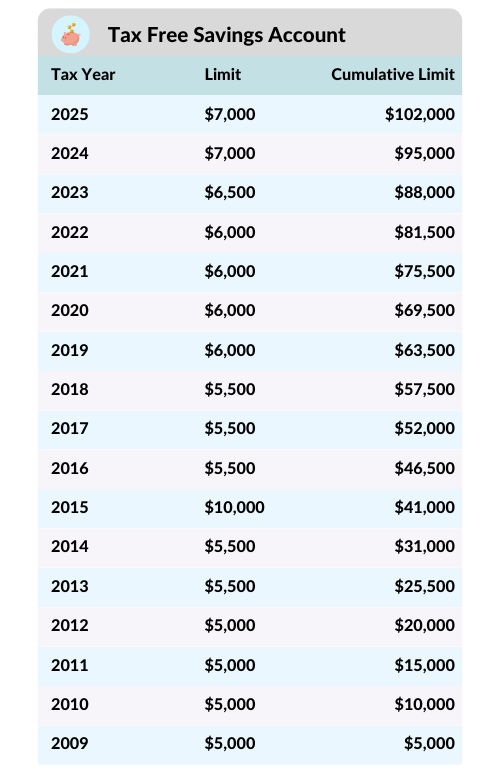
If you have never contributed to a TFSA since 2009, you can contribute up to $102,000 today. This table outlines the contribution amount you are allowed each year since TFSAs were created, including this year: 

Regarding RRSPs, the limit for tax deductions is 18% of your pre-tax earned income from the previous year, with a maximum limit of $32,490. To illustrate, if your pre-tax income in 2024 was $60,000, your deduction limit for 2024 would be $10,800 (18% x $60,000). If your pre-tax income was $200,000, the maximum limit of $32,490 would apply. 

How much contribution room can I carry forward? 

Suppose you opt not to contribute to your TFSA each year or do not contribute the maximum amount. In that case, you can carry forward your unused contribution room indefinitely, provided you are a Canadian resident, over 18 years of age, and have a valid social insurance number. If you make a withdrawal, the amount withdrawn will be added to your annual contribution room for the next calendar year. 

In contrast, for an RRSP, you can carry forward your unused contribution room until age 71. Once you reach 71, you are required to convert your RRSP into an RRIF. Withdrawals from an RRSP do not create additional contribution room.

The tax deductibility of contributions

Your TFSA contributions are not tax-deductible and are made with after-tax dollars. 

Your RRSP contributions are tax-deductible and made with pre-tax dollars. 

Tax Treatment of Growth 

It is essential to contribute to both RRSP and TFSA because of the different tax treatment of the growth within them. 

A TFSA is ideal for short-term goals, such as saving for a down payment on a house or a vacation, as its growth is entirely tax-free. When withdrawing from your TFSA, you will not have to pay any income tax on the amount withdrawn. On the other hand, the growth within an RRSP is tax-deferred. This means you will not pay taxes on your RRSP gains until age 71, at which point you convert the RRSP into an RRIF and start withdrawing money. 

RRSPs are more suitable for long-term goals such as retirement because, in retirement, you will have a lower income and be in a lower tax bracket, resulting in less tax on your RRIF income.

brandableContent

TFSA versus RRSP – Differences in withdrawals 

There are several areas to focus on when comparing differences in withdrawal: 

  • Conversion Requirements 
  • Tax Treatment 
  • Government Benefits 
  • Contribution Room 

Conversion Requirements 

For a TFSA, there are never any conversion requirements as there is no maximum age for a TFSA. 

For an RRSP, you must convert it to a Registered Retirement Income Fund (RRIF) if you turn 71 by December 31st, 2025. 

Tax Treatment of Withdrawals 

One of the most attractive things about a TFSA is that all your withdrawals are tax-free! Therefore, they are recommended for short-term goals; you don’t have to worry about taxes when you take money out to pay for a house or a dream vacation. 

With an RRSP, if you make a withdrawal, it will be taxed as income except in two cases: 

  • The Home Buyers Plan lets you withdraw up to $60,000 tax-free, but you must pay it back within fifteen years. 
  • The Lifelong Learning Plan lets you withdraw up to $20,000 ($10,000 maximum per year) tax-free, but you must pay it back within ten years. 

How will my government benefits be impacted? 

If you are withdrawing from your TFSA or RRSP, it’s essential to know how that will affect any benefits you receive from the government. 

Since TFSA withdrawals are not considered taxable income, they will not impact your eligibility for income-tested government benefits. 

RRSP withdrawals are considered taxable income and can affect the following: 

  • Income-tested tax credits such as Canada Child Tax Benefit, the Working Income Tax Benefit, the Goods and Services Tax Credit, and the Age Credit. 
  • Government benefits including Old Age Security, Guaranteed Income Supplement and Employment Insurance. 

How will a withdrawal impact my contribution room? 

If you withdraw from your TFSA, the amount you withdrew will be added on top of your annual contribution room for the following calendar year. If you withdraw from your RRSP, you do not open any additional contribution room. 

The Takeaway 

RRSPs and TFSAs can both be great savings vehicles. However, there are significant differences between them which can affect your finances. If you need help navigating these differences, please do not hesitate to contact us. We’re here to help.

Sources:

  • https://www.canada.ca/en/revenue-agency/services/tax/individuals/topics/rrsps-related-plans/registered-retirement-savings-plan-rrsp.html
  • https://www.canada.ca/en/revenue-agency/services/tax/individuals/topics/tax-free-savings-account.html

https://aquafinancialconsulting.com/wp-content/uploads/2025/02/TFSA-vs-RRSP-2025.png 300 500 Aquafinancial Consulting https://aquafinancialconsulting.com/wp-content/uploads/2020/04/aqua-logo-revised@2x.png Aquafinancial Consulting2025-02-06 12:02:112025-02-06 12:02:19TFSA vs RRSP 2025

RDSP Explained

November 1, 2024/in Blog, Disability, Family, Investment/by Aquafinancial Consulting

brandableContent

Registered Disability Savings Plan (RDSP) Explained

Planning for the future financial security of individuals with disabilities is a priority for many families. The Registered Disability Savings Plan (RDSP) is a valuable tool that offers long-term financial security through tax-deferred savings and government contributions. If you or a loved one qualifies for the Disability Tax Credit (DTC), the RDSP can help build a financial cushion for future needs.

What is the RDSP?

The RDSP is a savings plan designed to help individuals with disabilities save for their long-term financial security. It is a tax-deferred account, which means the investments grow tax-free while inside the plan, though taxes may apply upon withdrawal. The RDSP offers government assistance through the Canada Disability Savings Grant and the Canada Disability Savings Bond, significantly boosting savings for those who qualify.

Key Features of RDSP

– Tax-Deferred Growth: Investments grow without being taxed until withdrawn.

– Government Contributions: Depending on family income, the Canadian government may contribute through matching grants and bonds.

– Flexibility: Contributions can be made by the beneficiary, family, or friends.

– Lifetime Contribution Limit: Up to $200,000 in contributions, with no annual limit.

Eligibility Criteria for RDSP

To be eligible for the RDSP, the beneficiary must:

– Qualify for the Disability Tax Credit (DTC).

– Be a Canadian resident with a valid Social Insurance Number (SIN).

– Be under the age of 60 when the account is opened (contributions cease at 49 years old).

Government Contributions Explained

Canada Disability Savings Grant (CDSG): The government will match contributions up to 300%, 200%, or 100%, depending on the beneficiary’s family income and the contributions made.

For 2023, the income thresholds and matching rates are as follows:

– Family income of $106,717 or less:

   • 300% match on the first $500 contributed, giving up to $1,500 in grants.

   • 200% match on the next $1,000 contributed, giving up to $2,000 in grants.

– Family income over $106,717:

   • 100% match on the first $1,000 contributed, giving up to $1,000 in grants.

The maximum annual CDSG a beneficiary can receive is $3,500, and the lifetime maximum is $70,000. This grant is a powerful tool for enhancing your savings, as the government significantly boosts even modest contributions to the RDSP.

Canada Disability Savings Bond (CDSB) for 2023: The CDSB is available to low-income Canadians to help grow their RDSP even if they are unable to make regular contributions. 

For 2023, if the beneficiary’s family income is $37,908 or less, the government will contribute up to $1,000 annually to the RDSP without requiring any personal contributions.

– Families with incomes between $37,908 and $56,756 may receive a partial bond based on a sliding scale.

– The maximum lifetime CDSB contribution is $20,000.

Why Open an RDSP?

The RDSP is one of the most effective ways to save for individuals with disabilities, providing them with long-term financial security. By taking advantage of tax-deferred growth and government contributions, families can ensure that their loved ones have financial support when they need it most.

Contact us today. 

https://aquafinancialconsulting.com/wp-content/uploads/2024/11/Registered-Disability-Savings-Plan-RDSP-Explained.jpg 300 500 Aquafinancial Consulting https://aquafinancialconsulting.com/wp-content/uploads/2020/04/aqua-logo-revised@2x.png Aquafinancial Consulting2024-11-01 06:00:422024-11-01 06:00:45RDSP Explained

Understanding the Registered Education Savings Plan (RESP)

September 4, 2024/in Blog, Family, Investment, Registered Education Savings Plan/by Aquafinancial Consulting

brandableContent

Planning for your child’s education can be both exciting and overwhelming. The rising costs of post-secondary education make it important for parents and families to consider the financial tools available to help ensure children have the opportunity to pursue their educational dreams. One such tool is the Registered Education Savings Plan (RESP), a tax-deferred savings account specifically designed to help save for a child’s post-secondary education in Canada.

Eligibility and How to Open an RESP

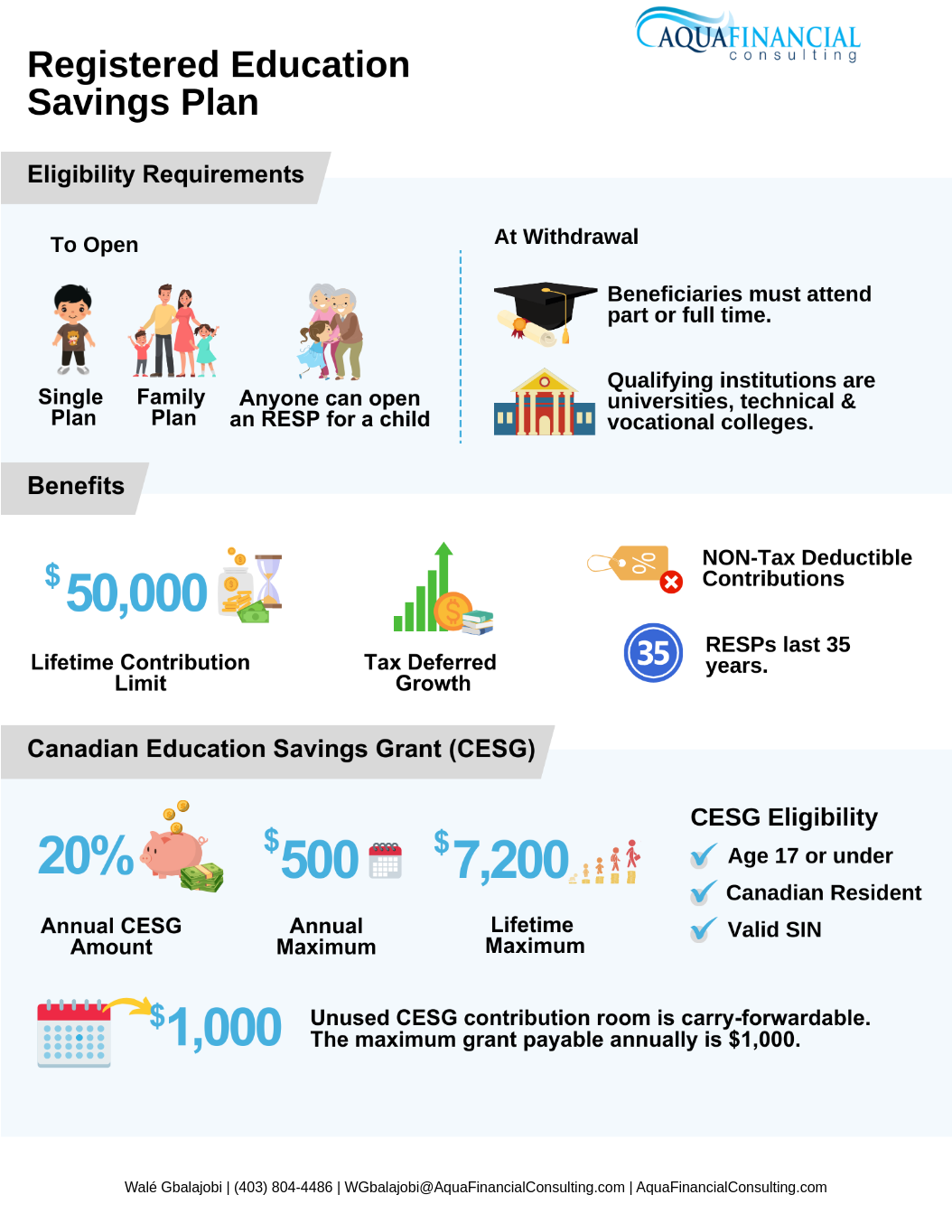
You can open a Single Plan for an individual beneficiary, such as your child, or a Family Plan if you wish to contribute to the education of multiple children in your family. The great news is that anyone can open an RESP for a child, whether you’re a parent, grandparent, or other family member, making it a versatile option for educational savings.

RESP Withdrawals and Beneficiary Requirements

RESPs can be used to cover a broad range of educational expenses. The only stipulation is that the beneficiary must attend a qualifying educational institution, which could be a university, college, or technical or vocational school. Withdrawals from the RESP will help support tuition, textbooks, living expenses, and more, as long as the student is enrolled part-time or full-time.

Key Benefits of an RESP

RESPs come with a range of benefits that make them an attractive savings vehicle for education:

– Lifetime Contribution Limit: You can contribute up to $50,000 over the lifetime of the plan for each beneficiary.

– Tax-Deferred Growth: While contributions to an RESP are not tax-deductible, the investment growth within the plan is tax-deferred. This allows your savings to grow faster, as taxes on the earnings are deferred until the funds are withdrawn.

– RESP Duration: You can keep the plan open for up to 35 years, giving you ample flexibility for when the funds may be needed.

Canadian Education Savings Grant (CESG)

One of the biggest incentives for opening an RESP is the Canadian Education Savings Grant (CESG). Through this program, the government will match 20% of your annual contributions, up to a maximum of $500 per year. Over time, this can accumulate to a lifetime maximum of $7,200 in CESG funds for each child. If you’re unable to contribute the maximum amount in a given year, the unused CESG contribution room is carry-forwardable, and you may be able to receive up to $1,000 in grant payments annually in future years.

Eligibility for CESG

To qualify for the CESG, the beneficiary must be:

– 17 years of age or younger

– A Canadian resident

– In possession of a valid Social Insurance Number (SIN)

A Smart Way to Save for the Future

Starting an RESP early can make a significant difference in how much you can save for your child’s education. With contributions that grow tax-deferred, along with generous government grants like the CESG, the RESP is a valuable tool to help ease the financial burden of post-secondary education. Planning for your child’s future today ensures that when the time comes, they can focus on their studies without worrying about the costs.

Consider opening an RESP to take advantage of the substantial benefits and opportunities this plan offers. Start investing in your child’s future today!

https://aquafinancialconsulting.com/wp-content/uploads/2024/09/Registered-Disability-Savings-Plan-RDSP-Explained.jpg 300 500 Aquafinancial Consulting https://aquafinancialconsulting.com/wp-content/uploads/2020/04/aqua-logo-revised@2x.png Aquafinancial Consulting2024-09-04 06:00:582024-09-04 11:52:47Understanding the Registered Education Savings Plan (RESP)
Page 1 of 41234

Search Blog Posts

Search Search

Latest News

  • Budget 2026: What the New Federal Measures Could Mean for Your MoneyNovember 6, 2026 - 10:51 am
  • How to Catch Up on Your RRSP ContributionsNovember 3, 2026 - 5:51 pm
  • Succession Planning for Business OwnersOctober 6, 2026 - 11:00 am

Categories

  • 2019 Only
  • 2020
  • 2020 Only
  • 2021
  • 2022
  • 2022 Only
  • 2023
  • 2024
  • 2025
  • 2026
  • Accountants
  • Archive
  • Article
  • Blog
  • Budget
  • Business owners
  • Buy Sell
  • Center of Influences
  • Charitable Gifting
  • Coronavirus
  • Coronavirus – associates
  • Coronavirus – practice Owners
  • Coronavirus – Retired
  • Coronavirus – Retiring
  • Coronavirus -students
  • Corporate
  • critical illness insurance
  • Debt
  • dental benefits
  • Disability
  • disability insurance
  • Estate planning
  • Family
  • farmers
  • financial advice
  • financial planning
  • Government Budget
  • group benefits
  • Health benefits
  • incorporated professionals
  • Individuals
  • Insurance
  • Investment
  • Life insurance
  • long term care
  • mortgage
  • Pension plan
  • personal finances
  • Professional Corporations
  • Professionals
  • RDSP
  • Registered Education Savings Plan
  • Retirees
  • Retirement
  • RRSP
  • Tax
  • Tax free savings account
  • travel insurance

Get in Touch

Aquafinancial Consulting
Walé Gbalajobi, BA, FICB, PFP
Financial Advisor
T: (403) 804-4486
aquafina@aquafinancialconsulting.com

3402 8 Street SE
Calgary, AB
T2G 5S7

Book an appointment for an online preliminary online meeting

Latest News

  • Budget 2026: What the New Federal Measures Could Mean for Your MoneyNovember 6, 2026 - 10:51 am
  • How to Catch Up on Your RRSP ContributionsNovember 3, 2026 - 5:51 pm
  • Succession Planning for Business OwnersOctober 6, 2026 - 11:00 am

About

We tailor all our financial consulting services to suit the needs of individual clients. We assign a team of dedicated personnel to work with every client. Our experienced personnel have years of experience in financial consulting making us ideal for all individual and small business financial consulting needs.

Sign up for our newsletter

* indicates required
©2020 Financial Tech Tools Inc. | Privacy Statement and Terms of Use
  • Link to LinkedIn
  • Link to Facebook
  • Link to X
Scroll to top Scroll to top Scroll to top