
Helping Employees Get the Most Out of Their Health Benefits

Helping Employees Get the Most Out of Their Health Benefits

You can provide the most generous benefits package in the world, but if employees don’t understand how to use it, it won’t have the impact you hoped for. Across Canada, many employees leave valuable health and wellness resources untapped simply because they don’t know what’s available or how to access it. For business owners and HR professionals, educating employees about their benefits isn’t just a nice extra—it’s an essential step toward creating a healthier, more loyal, and more productive workforce.

When Benefits Go Unused, Everyone Misses Out

Offering benefits is a major investment. Extended health coverage, dental care, paramedical services, and wellness allowances all come with costs to the company. When employees fail to take advantage of these resources, it’s not only a missed opportunity for them—it’s also a lost return on investment for the organization.

Imagine a scenario: an employee suffers ongoing back pain but doesn’t realize physiotherapy is covered under your plan. They avoid treatment, their pain worsens, and productivity drops. Months later, a preventable issue becomes a bigger concern that impacts both their well‑being and your team’s efficiency. This is what happens when benefits are underused—they don’t provide the intended health, morale, or retention impact.

Educating employees ensures they view benefits not as fine print in a handbook but as tools to support their daily lives. A team that knows how to access preventative health care, mental health services, and family coverage options is a team that stays healthier and feels more valued.

Why Health Benefits Education Can Be Challenging

Despite the clear value, helping employees understand health benefits often comes with hurdles.

Information overload on day one: New hires receive a mountain of onboarding materials. By the time they get to the benefits booklet, attention and energy are running low.

Confusing terminology: Words like “deductible,” “co‑insurance,” or “coordination of benefits” are not part of everyday language. Without translation into plain English, many employees tune out.

Irregular communication: Many organizations only discuss benefits once a year during open enrollment. Without reminders or ongoing conversations, details fade quickly.

Reactive awareness: Employees often learn about benefits only when a medical issue arises. By then, stress and urgency can make it harder to absorb new information.

Turning Health Benefits into Everyday Value

Clear and consistent communication helps employees view their benefits as practical tools rather than abstract policies. Here are strategies to bring health benefits to life:

Break information into small, digestible pieces
: Instead of a single benefits session, share one feature at a time. For instance, start with paramedical coverage one month, mental health supports the next, and vision care later. This keeps information approachable and memorable.

Use relatable examples
: Paint a picture of real-life use. “If your child needs braces, our dental plan can cover 50% of the cost up to $2,000” is easier to grasp than a page of percentages and annual maximums. Stories connect the benefit to employees’ daily lives.

Incorporate wellness education into your culture
: Lunch‑and‑learns, wellness newsletters, or quick “Did you know?” messages in internal chats can keep health resources top of mind. The goal is to normalize talking about benefits as part of workplace well‑being.

Highlight preventative care
: Preventative services—like annual eye exams, physiotherapy after minor strains, or mental health counselling—often save employees and employers from bigger issues down the road. When staff understand that benefits support staying healthy, not just reacting to illness, they’re more likely to use them proactively.

Offer multiple ways to learn
:
Some employees prefer reading a guide, others learn best through short videos, and some want to ask questions in a small group session. A mix of formats ensures the message reaches everyone.

Measuring the Impact of Your Efforts

It’s important to know whether your education efforts are working. Instead of guessing, consider these approaches:

Track utilization rates for paramedical services, wellness allowances, and mental health support. An increase often reflects better awareness.

Monitor enrollment levels for optional coverage, such as enrolling in optional critical illness protection.

Collect employee feedback via short surveys to gauge confidence in understanding their benefits.

Watch for retention improvements and fewer sick days, as engaged employees tend to stay longer and take a more proactive approach to their health.

Even small increases in understanding can create noticeable improvements in morale and the return on your benefits investment.

When employees know their benefits, they feel supported. When they use those benefits, they’re healthier, happier, and more productive. And when they see their workplace investing in their well‑being, loyalty naturally grows.

Helping employees understand their health benefits is an ongoing effort, not a single presentation. If your organization hasn’t revisited how benefits are communicated, this is a perfect time to start. A clear, proactive education strategy can turn an underused expense into a meaningful tool for engagement and wellness.

We can help you create a tailored communication strategy to educate your team, improve benefit utilization, and strengthen employee loyalty.

Disclaimer: This article is for informational purposes only and does not constitute financial, legal, or tax advice. Always consult a qualified professional regarding your specific situation. We are not responsible for any actions taken based on this content.

Insurance Planning for Incorporated Professionals
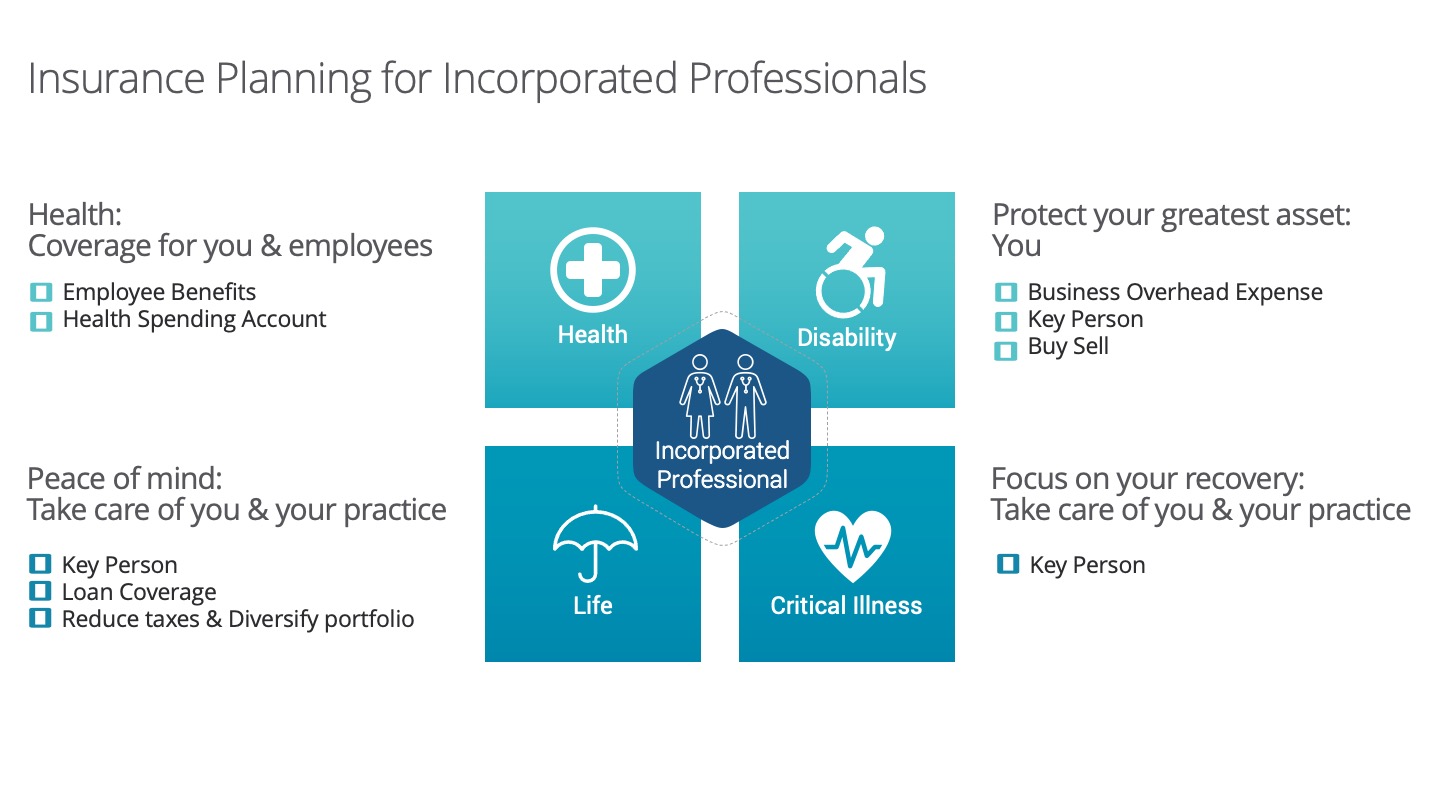
For incorporated professionals, making sure your practice is financially protected can be overwhelming. Incorporated professionals face a unique set of challenges when it comes to managing risk. Insurance can play an important role when it comes to reducing the financial impact on your practice in the case of uncontrollable events such as disability, or critical illness. This infographic and article address the importance of corporate insurance.

The 4 areas of insurance a incorporated professional should take care of are: 

  • Health 

  • Disability 

  • Critical Illness 

  • Life

Health: We are fortunate in Canada, where the healthcare system pays for basic healthcare services for Canadian citizens and permanent residents. However, not everything healthcare related is covered, in reality, 30% of our health costs* are paid for out of pocket or through private insurance such as prescription medication, dental, prescription glasses, physiotherapy, etc.

For incorporated professionals, offering employee health benefits make smart business sense because health benefits can form part of a compensation package and can help retain key employees and attract new talent.

For incorporated professionals that are looking to provide alternative health plans in a cost effective manner, you may want to consider a health spending account.

Disability: Most people spend money on protecting their home and car, but many overlook protecting their greatest asset: their ability to earn income. Unfortunately one in three people on average will be disabled for 90 days or more at least once before the age of 65.

Consider the financial impact this would have on your practice if you or a key employee were to suffer from an injury or illness. Disability insurance can provide a monthly income to help keep your practice running.

Business overhead expense insurance can provide monthly reimbursement of expenses during total disability such as rent for commercial space, utilities, employee salaries and benefits, equipment leasing costs, accounting fees, insurance premiums for property and liability, etc.

Key person disability insurance can be used to provide monthly funds for you or key employee while they’re disabled and protect the business from lost revenue while your business finds and trains an appropriate replacement.

Critical Illness: For a lot of us, the idea of experiencing a critical illness such as a heart attack, stroke or cancer can seem unlikely, but almost 3 in 4 (73%) working Canadians know someone who experience a serious illness. Sadly, this can have serious consequences on you, your family and business, with Critical Illness insurance, it provides a lump sum payment so you can focus on your recovery.

Key person critical illness insurance can be used to provide funds to the practice so it can supplement income during time away, cover debt repayment, salary for key employees or fixed overhead expenses.

Buy sell critical illness insurance can provide you with a lump sum payment if your business partner or shareholder were to suffer from a critical illness. These funds can be used to purchase the shares of the partner, fund a buy sell agreement and reassure creditors and suppliers.

Life: For an incorporated professional, not only do your employees depend on you for financial support but your loved ones do too. Life insurance is important because it can protect your practice and also be another form of investment for excess funds.

Key person life insurance can be used to provide a lump sum payment to the practice on death of the insured so it can keep the business going until you an appropriate replacement is found. It can also be used to retain loyal employees by supplying a retirement fund inside the insurance policy.

Loan coverage life insurance can help cover off any outstanding business loans and debts.

Reduce taxes & diversify your portfolio, often life insurance is viewed only as protection, however with permanent life insurance, there is an option to deposit excess funds not needed for operations to provide for tax-free growth (within government limits) to diversify your portfolio and reduce taxes on passive investments.  

Talk to us to make sure you and your practice are protected.

Group Retirement Benefits

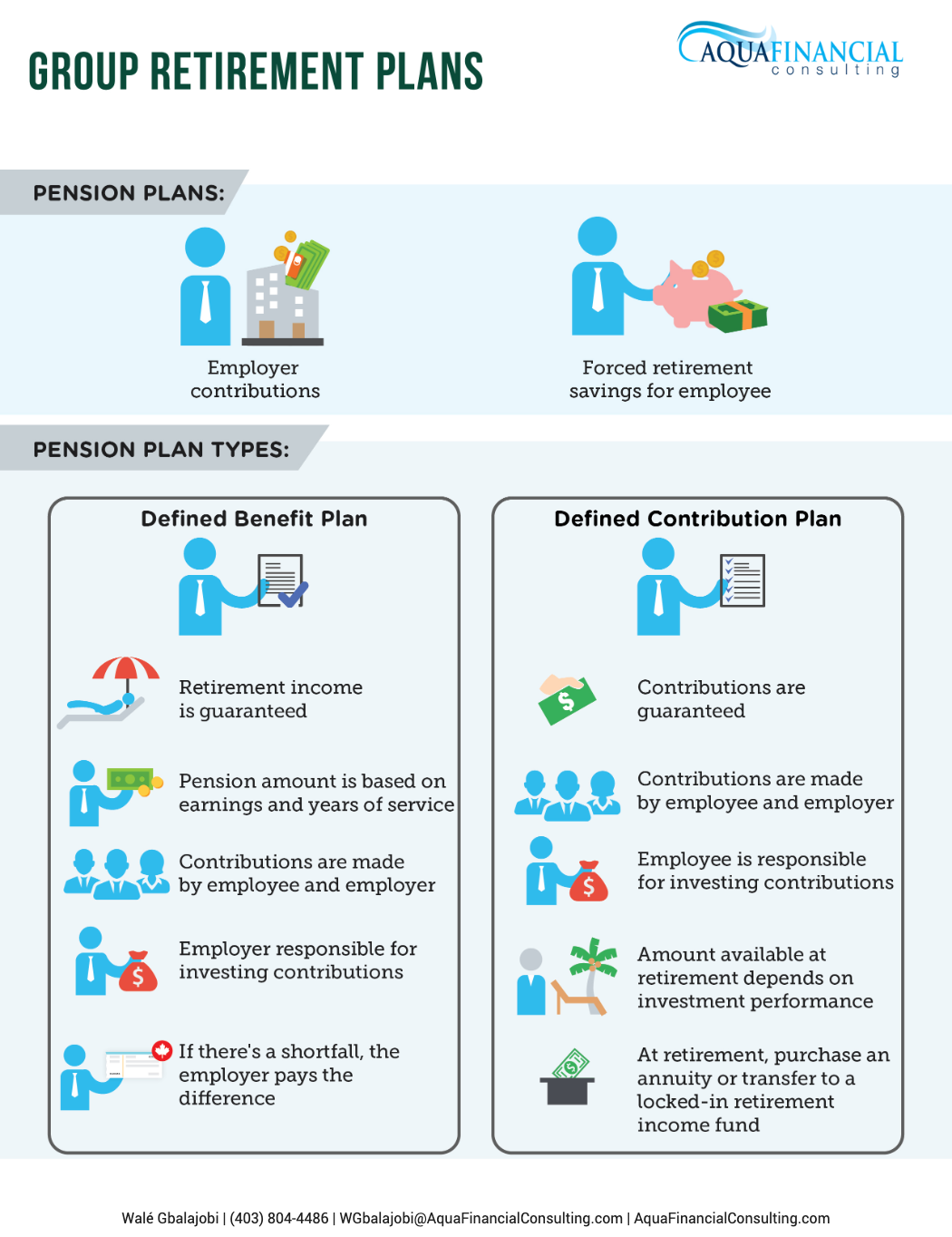
Working at an organization that offers a pension plan is one of the greatest financial advantages a Canadian can enjoy. Pension plans are designed to provide retirement income and help employees reach their retirement goals and for business owners- help retain key employees.

Pension plans can offer:

  • Employer contributions

  • Forced retirement savings for employee

There are 2 main types of pension plan:

  • Defined Benefit Plan

  • Defined Contribution Plan

Defined Benefit Plan

  • Retirement income is guaranteed, contributions are not.

  • The pension amount is based on a formula that includes the employee’s earnings and years of service with the employer

  • Usually, contributions are made by the employee and employer

  • The employer is responsible for investing the contributions to ensure there’s enough money to pay the future pensions for all plan members.

  • If there’s a shortfall, the employer pays the difference.

Defined Contribution Plan

  • Contributions are guaranteed, retirement income is not.

  • Usually, contributions are made by the employee and employer.

  • The employee is responsible for investing all contributions.

  • The amount available in retirement depends on how the investment performs including total contributions.

  • At retirement, the money in the account can be used to generate retirement income through purchasing an annuity or transferring the amount to a locked-in retirement income fund.

In summary, a defined benefits plan guarantees you a retirement income and a defined contribution plan guarantees contributions but not retirement income.

Talk to us, we can help.

Group Insurance vs Individual Life Insurance

Group Insurance vs Individual Life Insurance

“I already have life insurance from work, so why do I need to get it personally?” or “Work has got me covered, I don’t need it.”

While it’s great to have group coverage from your employer or association, in most cases, people don’t understand that there are important differences when it comes to group life insurance vs. self owned life insurance.

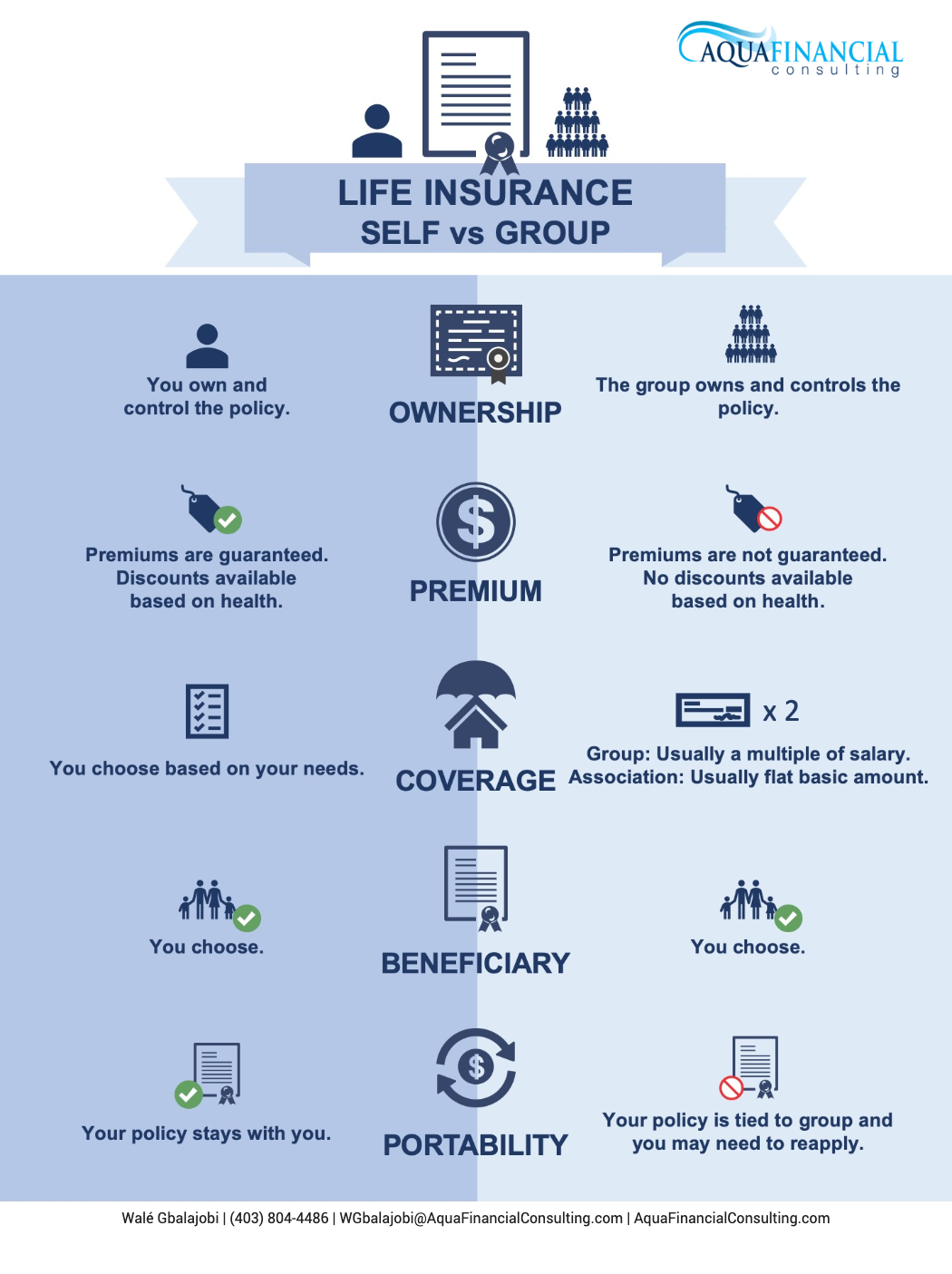
Before counting on insurance from your group benefits plan, please take the time to understand the difference between group owned life insurance and personally owned life insurance. The key differences are ownership, premium, coverage, beneficiary and portability.

Ownership:

  • Self: You own and control the policy.

  • Group: The group owns and controls the policy.

Premium:

  • Self: Your premiums are guaranteed at policy issue and discounts are available based on your health.

  • Group: Premiums are not guaranteed and there are no discounts available based on your health. The rates provided are blended depending on your group.

Coverage:

  • Self: You choose based on your needs.

  • Group: In a group plan, the coverage is typically a multiple of your salary. If your coverage is through an association, then it’s usually a flat basic amount.

Beneficiary:

  • Self: You choose who your beneficiary is and they can choose how they want to use the insurance benefit.

  • Group: You choose who your beneficiary is and they can choose how they want to use the insurance benefit.

Portability:

  • Self: Your policy stays with you.

  • Group: Your policy is tied to your group and if you leave your employer or your association, you may need to reapply for insurance.

Talk to us, we can help you figure out what’s best for your situation.

10 Essential Decisions for Business Owners

10 Essential Decisions for Business Owners

Business owners are busy… they are busy running a successful business, wearing lots of hats and making a ton of decisions. We’ve put together a list of 10 essential decisions for every business owner to consider; from corporate structure to retirement and succession planning:

  • Best structure for your business (ex. Sole Proprietor, Corporation, Partnership)

  • Reduce taxes

  • What to do with surplus cash

  • Build employee loyalty

  • Reduce risk

  • Deal with the unexpected

  • Retire from your business

  • Sell your business

  • Keep your business in the family

  • What to do when you’re retired

As a financial advisor, we are uniquely positioned to help business owners, talk to us about your situation and we can provide the guidance you need.